A car is built once. After that it changes hands, paperwork and owners many times, and every one of those moments is a chance for something to go wrong.
What they do
iDocCar describes itself as the governance layer for vehicle processes. It manages what happens to a vehicle's paperwork and process after it leaves the factory: the purchase, the administrative procedures, the campaigns and special assistance, the scanning of documents, the digital signature and safe custody of contracts. The distinction it draws matters. A document management system stores what happened. iDocCar controls how each step is carried out, so that errors and deviations are caught before they reach the business, with a full trail of who did what and when.
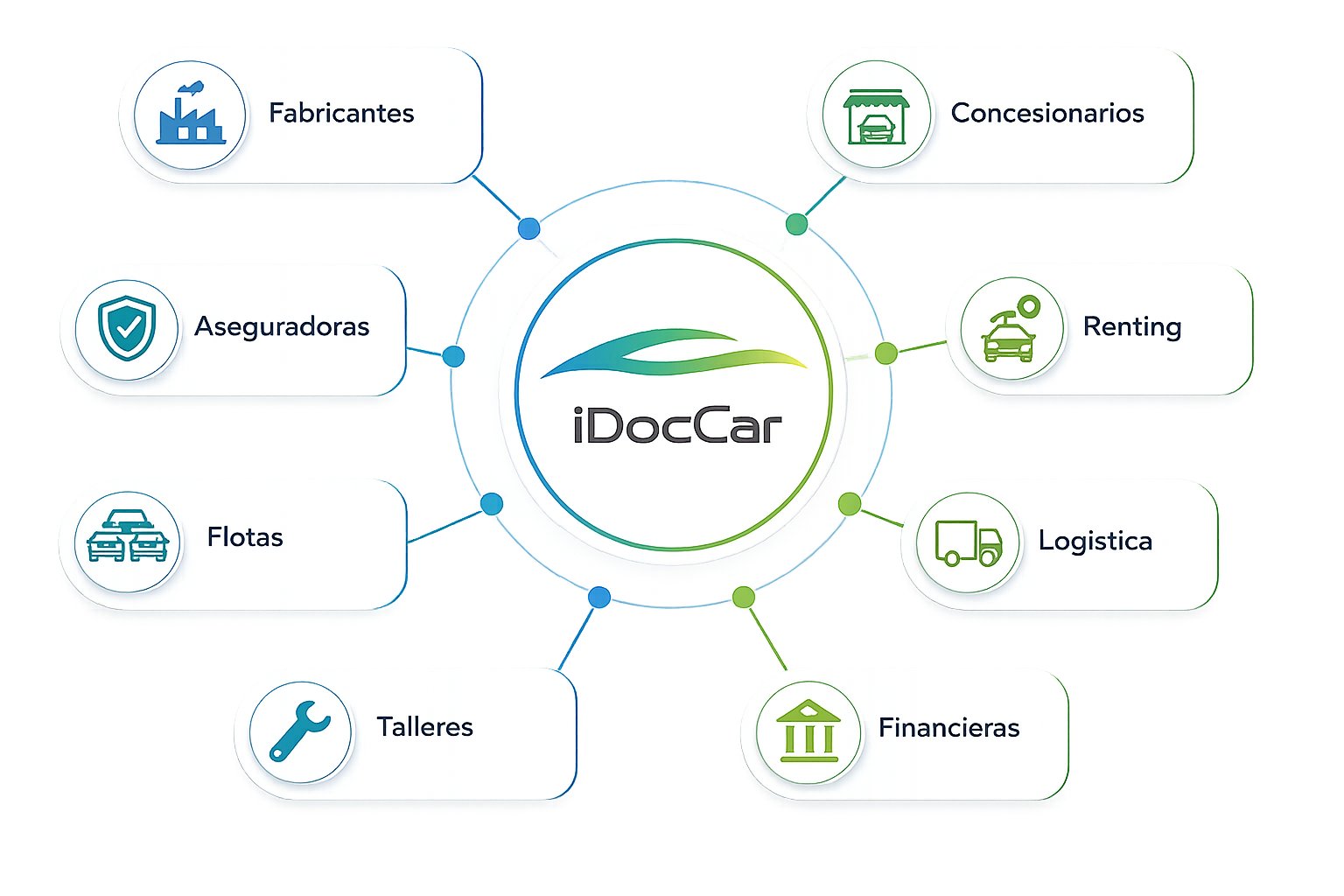
It works across the whole chain a vehicle travels through: manufacturers and importers, dealership groups, distributors and logistics firms, rental and fleet companies, and now insurers, finance companies and workshops. Revenue comes in roughly equal thirds from dealerships, distributors and logistics. The company says it runs in more than 500 dealerships with more than 3,000 active users across six countries, including Spain, Portugal and Italy, with a logistics client operating in fourteen or fifteen European countries and plans in Mexico. It holds ISO 27001 and TISAX certification, the security standard the German car industry expects of its suppliers. In one published case, Volkswagen Group Retail Spain, which runs 58 sites for Audi, Volkswagen, SEAT and Škoda, reported savings of 1.5 million euros in the first year.
Miguel Morenés Bertrán, co-founder and co-chief executive, spent several years in the financial and administrative side of the Bergé group's automotive companies before founding Acerca Partners in 2014, the company behind iDocCar. Two co-founders run it as co-chief executives with a board of directors. It has 25 people, around 19 of them technical and all in-house. It was funded by business angels, grows between 20 and 30 per cent a year, has not lost a large client in seven years, and is not raising: it is working to a four-year plan from 2026, with a new finance director and sales manager hired for the move from startup to scale-up.
The software around a car is well developed. CDK Global, Reynolds and Reynolds and Cox Automotive run the dealer management systems most American dealerships live inside, Keyloop does the same across much of Europe, and Tekion is rebuilding the dealer system with AI at its core. On the paperwork side, Docusign and Signaturit, whose signature technology iDocCar builds on, handle the signing. Every one of them is built around a single organisation, usually the dealer. iDocCar describes itself as complementing those systems rather than replacing them, and the reason is where it sits.
The point: the money is in the handoffs, not inside any one company
Every big automotive software company owns a building. The dealer management system owns the dealership. The manufacturer's systems own the factory. The finance company has its own, and so does the insurer, the logistics firm and the workshop.
Nobody owns the space between them, and that is where a car actually spends its life. A vehicle moves from the factory to an importer, to a distributor, onto a truck, into a dealership, through a finance company and an insurer, out to a customer or a rental fleet, and later through a workshop. Every one of those moves produces documents with legal weight: contracts, registrations, transfers, inspections. Each is a moment where a missing signature or a wrong form costs real money and real time.
iDocCar has chosen to live in the handoffs. It is not trying to beat the dealer system inside the dealership. It governs the process that runs between companies, which no single company's system can see from end to end.
That position has a pleasant property for the business. iDocCar charges on a pay-per-use basis, so it is paid as vehicles move. It does not have to persuade anyone to do more of anything. Every car that passes through the chain passes through iDocCar, and when its customers grow, it grows with them. It helps explain how it has kept its clients for seven years and grows steadily without needing to raise money.
Why AI makes the position stronger
A process that has been governed and recorded step by step is exactly the kind of process AI can begin to run. The company is building an AI layer into the product, with people checking its work, and Miguel is clear about what AI is already doing inside the company: it lets revenue grow without adding people at the same rate.
This is the quiet advantage of having structured the handoffs first. A company whose paperwork is scattered across email and filing cabinets cannot hand much of it to an AI. A company that has already standardised, governed and recorded every step can, and iDocCar is the one holding those steps.
Where else this works
This part is opinion rather than anything the company has said.
The formula is to look for an asset that passes through many companies' hands, where every handoff produces paperwork with legal weight and each company's software stops at its own front door. Property transactions, with agents, lenders, notaries and registries. Shipping containers, with carriers, ports, customs brokers and hauliers. Aircraft parts, which must carry their history with them. Medicines moving through the cold chain. Used industrial equipment. Freight crossing borders. In each of them the most valuable software position is not inside the biggest company. It is the layer that governs the handoffs between all of them.
Why it is bigger than it sounds
The short description is document software for car dealers. The position underneath it is wider than that.
- It owns the space between companies. Dealer, manufacturer, finance and insurer systems each stop at their own door, and iDocCar governs the process that runs between them.
- It is paid as vehicles move. Pay-per-use pricing means growth comes with the volume of cars, not with persuading anyone to buy more.
- Governed processes are the ones AI can run. Having standardised the handoffs first is what lets an AI layer take on more of the work.
What to watch
The measure is North America. The market is large and the big dealer systems are deeply embedded, and Miguel has already found that connecting to them is the hard part. An integration partnership with one of those systems would open the continent. Without one, every dealership is a separate negotiation.
The second is how far beyond the dealership the platform reaches. Insurers, finance companies and workshops are newer customers, and each one added makes iDocCar more central to the whole chain rather than useful to one link of it.
The third is the step from startup to scale-up that the new finance director and sales manager were hired for. Steady growth with no lost clients is an unusually solid base for it.