For someone with diabetes, every meal is a small maths test. How many carbs are on this plate? How fast will they hit? How much insulin covers them? The doctor explains it all clearly in the exam room. Then the patient goes home, sits down to dinner, and has to work it out alone, three times a day.
CosMeal is built for that moment at the table, and for the next visit to the doctor.
What they built
CosMeal, made by Cosmio in Vancouver, is an app for eating well with diabetes. It works in one cycle: log, analyse, plan.
To log a meal, you take a photo or simply describe it. CosMeal's AI assistant, Bao, recognises the whole dish at once, rice, beans, meat and vegetables together, rather than making you search a database for each ingredient. It gives a range of carbs instead of pretending to be exact, and each person at the table can log their own portion. Because it works from what it sees and what you tell it, it can log home cooking, a family recipe or a takeaway that no food database has ever listed.
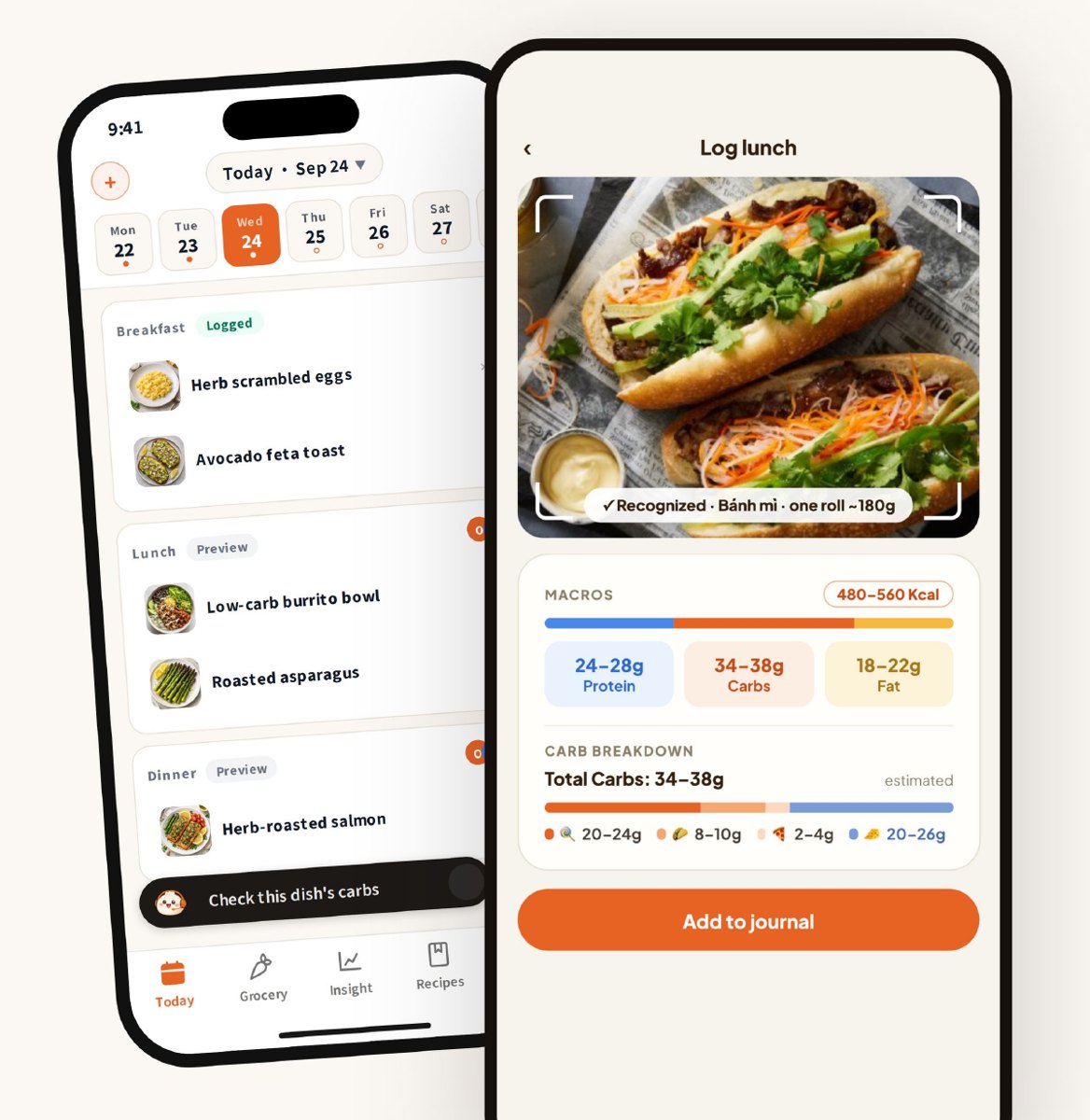
Then it scores each week against goals the user picks, from "carb smart" and losing fat to less salt or low purine for gout, with every score based on published guidance such as the American Diabetes Association's plate method. Bao suggests a specific change, not "eat more vegetables". When someone wants it, Bao also plans the week's meals for the whole family, with each person's allergies and tastes, using more than 2,000 recipes, each high-carb dish paired with a low-carb version, and sends the shopping list to Instacart.
In the company's own tests, CosMeal's carb estimates beat general AI models and trained people. Calibrated on a public research dataset of photographed meals, it scored 70 out of 100 from a photo alone, and 81 to 85 once the user adds a one-line description. On the same scale, registered dietitians judging from photos in a 2021 study scored about 59.
Carbs come in speeds
The detail that sets CosMeal apart is that it splits the carbs in every dish by how fast they reach the blood. Sugar and white bread act within about 30 minutes, rice and pasta over about three hours, whole grains over about five. Protein and fat matter too: hours after a meal, some of them turn into glucose as well, so CosMeal converts them into carb equivalents.
That matters because insulin works on a timeline. If the food and the insulin do not line up, blood sugar spikes and then crashes. People who use Loop, the open-source system that links a glucose monitor to an insulin pump, already have to enter how fast each meal's carbs will act. CosMeal is the first app, the company says, to estimate it from a photo.
CosMeal does not calculate insulin doses. That stays with the patient's care team.
Built with the clinic
CosMeal was built by doctors and patient families. Bill Liu, the founder and chief executive, is a University of British Columbia graduate and former full-stack engineer at Fortinet, and Bill's wife lives with type 1 diabetes. Gary, the co-founder and chief technology officer, also came from Fortinet and leads the engineering and AI. Olivia, who leads product and marketing, has a father and an aunt at high risk of diabetes.
Its chief medical advisor is Dr. Tom Elliott, founder and medical director of BC Diabetes, a clinical associate professor at UBC with more than 30 years in diabetes care. "Accurate carb counting is the cornerstone of rapid insulin therapy," Dr. Elliott says on CosMeal's website. "I recommend CosMeal for all rapid insulin users."
BC Diabetes, which cares for more than 13,000 patients, is CosMeal's official clinical partner. More than 30 of its clinicians each have their own account, and their feedback goes straight into the product. The two are planning a joint clinical trial in 2027, led by Dr. Elliott. CosMeal launched at BC Diabetes two weeks ago and already has 850 users. It is also working with the University Village Medical Clinic at UBC, which has more than 9,000 registered patients, and a family dental clinic.
Next, CosMeal is designing a test-meal feature with Dr. Elliott. It pairs the food journal with insulin and glucose readings to help doctors work out a patient's insulin-to-carb ratio, the number of grams of carbs that one unit of insulin covers. As far as the company knows, no other app offers a structured test meal built for the care team.
There are plenty of food apps. MyFitnessPal logs calories from a huge database. Cal AI and SnapCalorie scan meals with AI. mySugr logs blood sugar for people with diabetes, SNAQ scans meals for them, and Carb Manager serves low-carb and keto dieters. The apps that log meals do not plan them, the ones that plan do not log, and none of them, by CosMeal's count, splits carbs by speed or writes a report for the doctor.
The point: the weekly report is the way in
The doctor gives four pieces of advice in the exam room: count the carbs in every meal, understand your carb ratio, follow the dietary advice, and eat low-carb with healthy fats. At home, every one of them falls apart. The patient guesses the carbs, forgets the advice by dinnertime, and has no way of knowing how they are doing.
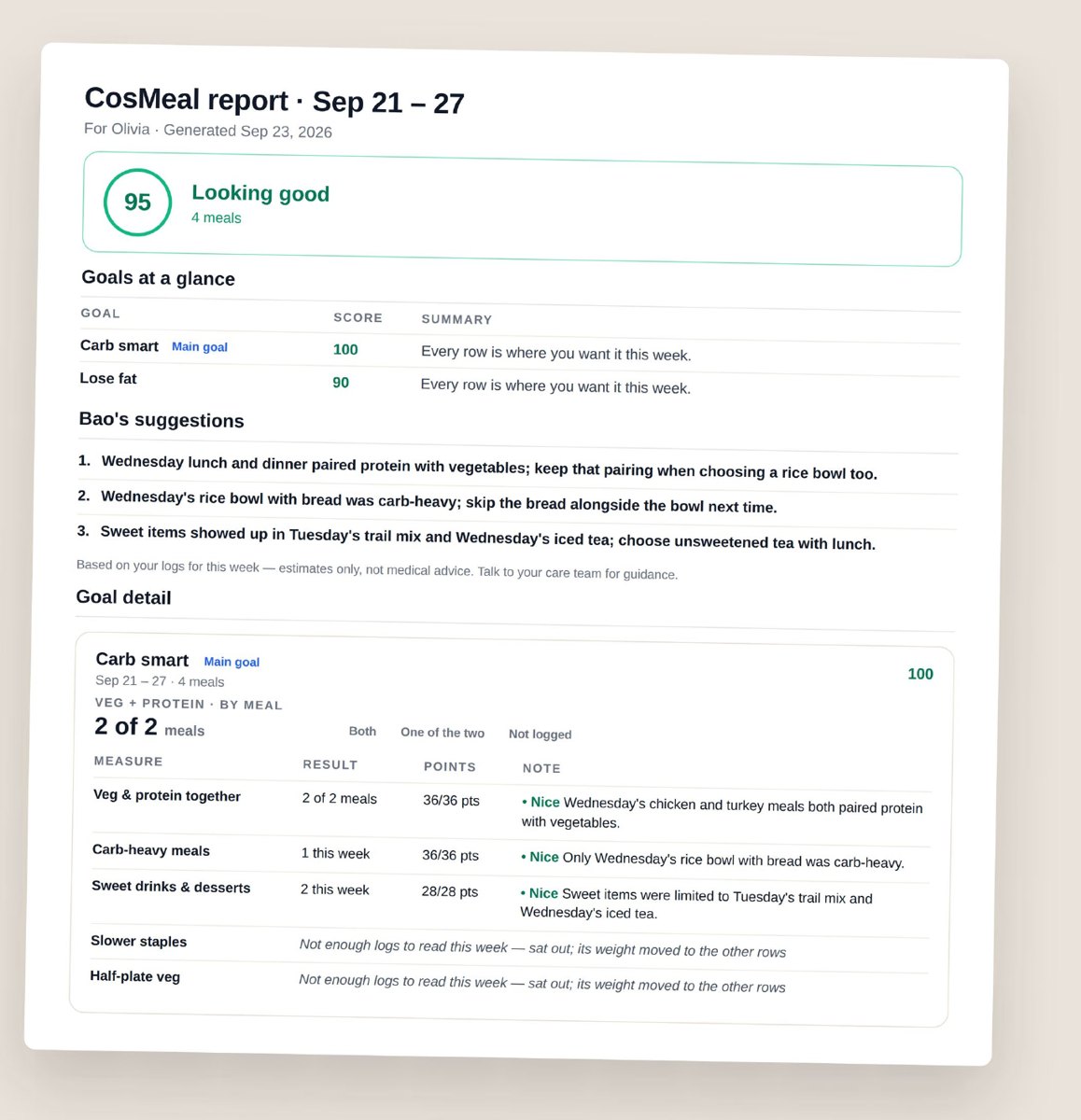
So CosMeal's most important feature is a page. Before an appointment, the patient exports a weekly report in one tap: the full food log, a score for each goal with the rule behind it, and Bao's suggestions written for the doctor. The doctor reads the week in minutes and spends the visit adjusting the plan.
That report is also how CosMeal grows. A clinic recommends the app, the patient signs up with a QR code, and the report comes back to the clinic at the next visit. Patients pay a monthly subscription, and clinics pay for the doctors' tools. Every report makes the doctor trust the app a little more, and a doctor who trusts it recommends it to the next patient. CosMeal is raising its first round now, and doctors and Silicon Valley investors are taking part.
Where else this works
This part is opinion rather than anything the company has said.
The same move fits any condition that is managed at home between short visits to a doctor. Blood pressure, kidney disease, gout, pregnancy, recovery after surgery, physiotherapy and mental health all depend on what a patient does on the days the doctor never sees. The tool that turns those days into one page a doctor can read in minutes earns the doctor's trust, and the doctor's recommendation is the cheapest and most trusted way to reach the next patient. CosMeal already has goals for heart health, kidney care, gout, pregnancy, children and healthy ageing, so it is heading there itself.
Why it is bigger than it sounds
The short version is a food app for diabetes. The bigger idea is simple.
- Carbs have speeds. CosMeal tells you not only how many carbs are on the plate, but how fast they will hit, which is what insulin needs to know.
- The doctor gets a page, not a guess. One weekly report turns a patient's home life into something a doctor can act on in minutes.
- Doctors bring the next patient. When a clinic trusts the report, it recommends the app, which is how CosMeal grows.
What to watch
The measure is the 2027 clinical trial with BC Diabetes. Better blood sugar control in a real trial would turn a promising app into one doctors can prescribe with confidence.
The second is how many clinics join. CosMeal plans to bring in 10 to 20 diabetes clinics, and each one is a stream of patients who arrive already trusting it.
The third is how far 850 users in two weeks can go once more clinics are on board.