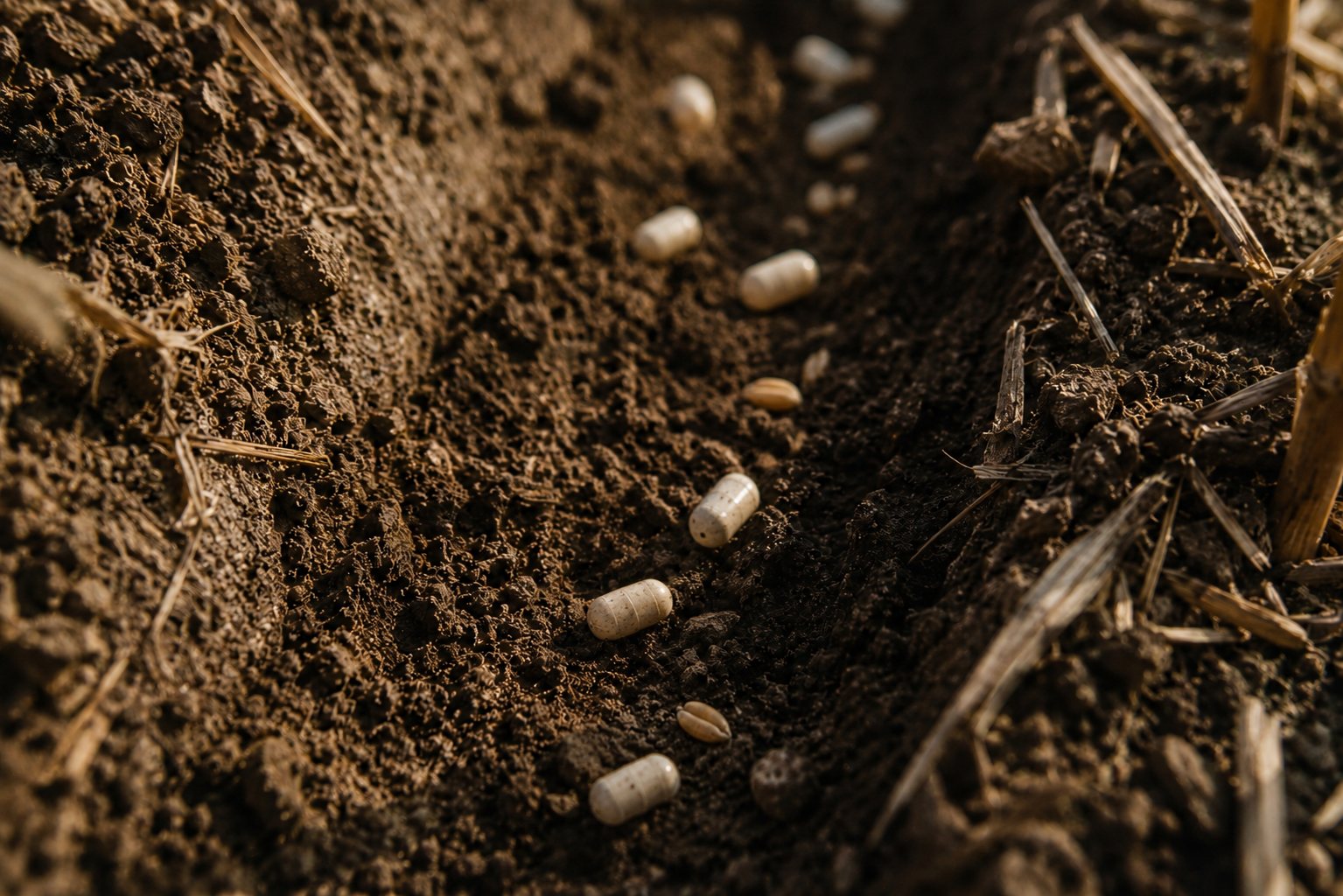
Farming has products for the chemistry of soil and products for its biology. For the physical structure of soil, the thing everything else depends on, it has had only one answer for a century: drive a heavy machine over it and break it open.
Muju Earth has made soil structure something you can sow.
What they built
Muju Earth, a London startup, makes Aeropod: a biodegradable capsule about the size of a seed. Farmers drill it into the ground alongside their seeds, using the planting machines they already own, at about five capsules per square metre. When the soil gets compacted, or heavy rain leaves it waterlogged, the capsule breaks the soil open around it, making tiny cracks that let air and water back in. Chief executive Lu Afolayan describes it as working like popcorn popping, except the trigger is the soil itself rather than heat. Capsules can also be set to open at a chosen time.
Two things make it different from ploughing. Some capsules open later than others, so the soil gets help all season long, while a plough passes over the field once. And when the job is done, the capsule is gone. It contains no plastic and breaks down completely within 24 weeks. The farmer plants a fresh batch the next season. The design is patent pending.
The company grew out of a student project on the Innovation Design Engineering master's programme run by Imperial College London and the Royal College of Art. It is led by Lu Afolayan, the chief executive, whose background is in agricultural research and development, with time at the Royal Academy of Engineering, Huawei and Biofonic, and Ocean Hu, the chief technology officer, a materials and product designer who grew up in a farming family in China. The company is fully independent: Imperial does not own the intellectual property.
What the numbers say
In lab trials, water soaked into soil treated with Aeropods 500 per cent faster, and seed emergence rose from 13 per cent of seeds to 63 per cent. Cost is the other half of the story. Aeropods cost about £100 per hectare, against £250 to £500 for a single pass of heavy tilling, and they also cut the diesel, labour and machinery that ploughing needs.
Farmers are already paying attention. The company has £235,000 in orders, six letters of intent, four paid pilots with distributors on three continents, and 650,000 capsules pre-ordered for 2027. More than 30 farms are on its waiting list. It has won more than 20 awards and £365,000 in grants without giving up any of the company, and has been featured in Farmers Weekly and TechCrunch.
The people closest to the soil like what they see. Andrew Richards, a senior agronomist with 40 years of experience, called it "a good bit of lateral thinking to solve an increasing problem." Bruce Stops, who farms 800 acres in the UK and is moving to regenerative farming, says the farm's costs come from diesel, machinery, labour and inputs, and that Aeropods could reduce all of them.
Soil is a busy field for investors. Yara and the other fertiliser giants own the chemistry. Pivot Bio and Indigo Ag built large businesses on biology, with microbes that do some of fertiliser's work. Loam Bio and Agreena help farmers get paid for the carbon healthier soil stores. And the physical side of soil still belongs to the makers of tillage machinery, John Deere above all. Almost nobody has tried to sell soil structure as an input, because almost nobody thought it could be one.
The point: a new kind of input, built so nobody has to change how they farm
Lu Afolayan puts the history simply. For a hundred years, the industry improved soil chemistry, and more recently soil biology. The physical structure that both depend on never got the same care. Fixing it meant tilling and ploughing, which breaks the soil open today and damages its structure over time, so farmers have been protecting this year's harvest at the cost of future ones.
Aeropod turns soil structure into an input, sold and sown the way seed and fertiliser are. Fertiliser is for chemistry, microbes are for biology, and Aeropod is designed to be the first product for soil physics, across crops and soil types.
What makes it work as a business is a line Lu Afolayan repeats: agriculture rarely has an innovation problem, it has an adoption problem. Plenty of good ideas never reach a field because they demand new machines, new habits or new suppliers. Aeropod was designed with farmers to need none of those. In the company's words, it is built like a seed, sown like a seed and ships like a seed. The farmer uses the planter already in the shed, buys through the distributor they already use, and pays per hectare, every season.
That last part is the best shape a business in farming can have. Seed and fertiliser companies are among the most durable businesses in the world because farmers buy again every year. An input that has to be replanted each season brings in money every season. The company makes the capsules through manufacturing partners at a 40 per cent gross margin.
The yield penalty that stops farmers going regenerative
The clearest way to see the opportunity is through the farmer who wants to stop ploughing.
No-till farming, the heart of regenerative agriculture, leaves the soil undisturbed so its structure and life can recover. The problem is that the first years are painful. Without tilling, compacted soil stops seeds coming up and yields drop, often sharply, and many farmers cannot afford that drop.
Aeropod makes no-till workable by doing the structural work through the season, so the farmer can stop tilling without taking the yield hit. The company is starting with the crops where compaction hurts most, such as potatoes, onions and tomatoes, and with food companies that have promised to cut their emissions.
The stakes are large. About 40 per cent of the world's soils are already degraded. In the UK alone, damaged topsoil costs about £1.2 billion a year, and four million hectares are at risk of compaction. The company estimates that Aeropods on just one per cent of UK soils would avoid about 400,000 tonnes of carbon dioxide over ten years, roughly the same as taking 200,000 cars off the road.
Next stop: Silicon Valley
Muju Earth is one of 200 startups selected for TechCrunch Disrupt on 10 October, and will also pitch in a Silicon Valley agritech challenge with around a million dollars of investment at stake. The founders will be in the Bay Area from 10 to about 18 October, then in Los Angeles until 25 October, and in Canada in November.
Lu Afolayan is open about the gap: the company's network is in the UK, with Imperial, research bodies, partners and farmers, and it does not yet know people in the American market. The trip is meant to change that, and the founders want to meet investors, growers and farming partners while they are there. The company is raising a £1.1 million pre-seed round to carry it through the next 26 months.
Where else this works
This part is opinion rather than anything the company has said.
The move travels to any traditional industry where the fix for a physical problem has always been a heavy machine or a disruptive job. Turn the fix into a consumable that slots into the routine people already have, sold through the channel they already buy from, and replaced on a cycle they already follow. Concrete that repairs its own cracks. Additives that keep water pipes from scaling. Road surfaces that drain themselves. Treatments that rebuild mine and quarry land as it is restored. In each case the winning product is not a better machine. It is the thing that makes the machine unnecessary and arrives in the same truck as everything else.
Why it is bigger than it sounds
The short version is a small capsule for soil. The idea behind it is much bigger.
- It is a new kind of product. Farmers buy fertiliser for chemistry and microbes for biology. For the structure of soil they only had machines. Aeropod is the first thing they can buy and sow instead.
- Farmers do not have to change anything. It goes in with the seed, using the same machines and the same suppliers.
- Farmers buy it every year. Like seed and fertiliser, it is used up each season and bought again.
What to watch
The measure is the field results. Farming gives one harvest a year, so each season of data is precious, and how many seedlings come up with Aeropod compared with tilling is the number that will decide everything.
The second is the pre-seed round and who leads it. An investor who understands farm inputs and distribution would be worth more than the money.
The third is what the American trip produces. The company has the product, the orders and the UK base. A first set of US growers and distributors would turn a promising British startup into a transatlantic one.