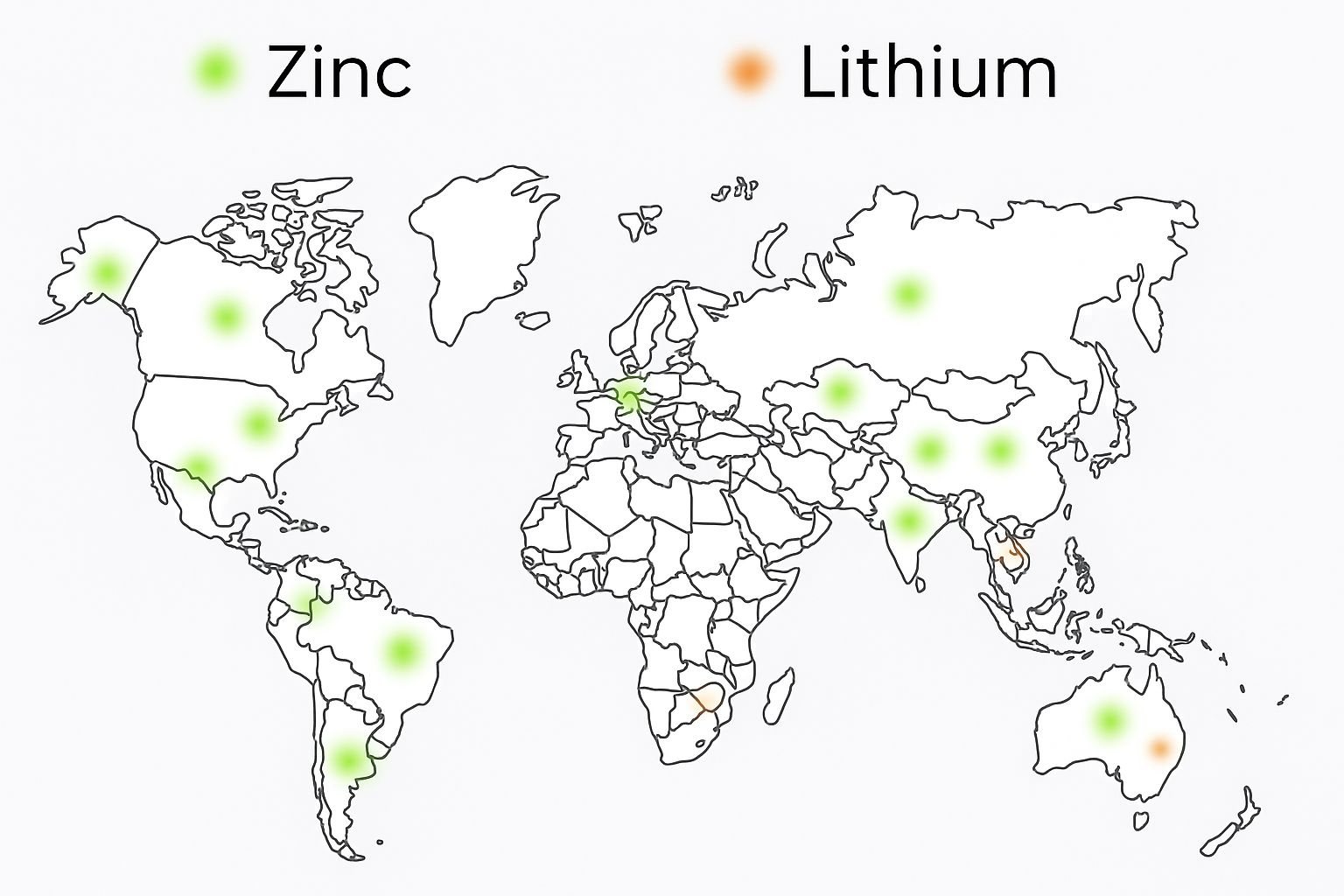
Lithium is very good at being light. For a great many of the batteries now being bought, light is not the point.
What they built
Control Z, which writes its name CTRL+Z and trades as CTRL+Z Energies, makes zinc-ion battery cells. Instead of lithium, cobalt or nickel, it uses zinc, which is abundant, cheap and easily recycled, together with a patented hybrid cathode and a water-based electrolyte. Water does not burn, so the cell cannot catch fire, which is the part of the pitch that matters most.
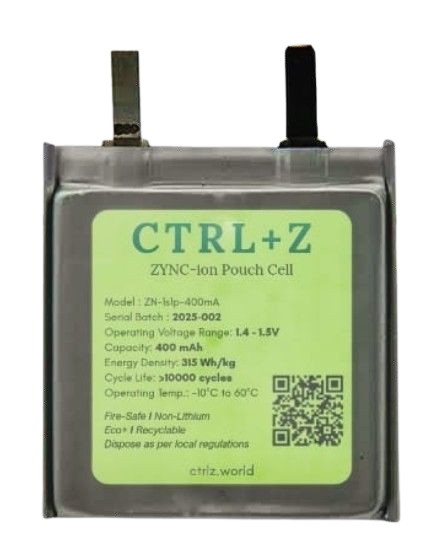
The company's own figures are ambitious. It says its cells reach 350 watt-hours per kilogram, keep more than 90 per cent of their capacity after 10,000 cycles, and can charge fully in about two minutes, with the cycle life and charging performance independently tested by TÜV NORD in India. It estimates the cost of storing energy over the cell's lifetime at around three cents per kilowatt-hour, and says that because the chemistry needs no dry room to manufacture, a factory costs 40 to 50 per cent less to build than a lithium one. These are the company's numbers at cell level, not a product shipping in volume.
It has three pilot engagements with French industrial partners, a stationary storage pilot with Siemens in India, and backing or support from the 776 Foundation started by Reddit co-founder Alexis Ohanian, and the Audi Environmental Foundation. The founder and chief executive is K V S Pavan Choudary, who trained in nanotechnology and computational materials science. The company was founded in Hyderabad and is now a French company based in Lille.
Batteries are one of the most crowded and heavily funded fields in the world. CATL dominates lithium. In France alone, Verkor and ACC are building lithium gigafactories in the same region Control Z has moved to. Among the alternatives, Eos Energy builds zinc-based storage for the grid, Salient Energy in Canada is working on zinc-ion cells, and Form Energy is betting on iron and air for storage that lasts days. Almost all of them are trying to beat lithium at its own game, on price or on how much energy fits in a kilogram. Control Z is choosing where not to play it.
The point: pick the customer for whom lithium's weakness is the whole problem
Lithium won the battery war on one axis: it stores a lot of energy in very little weight. That is exactly what a phone or a car needs, and it is why nearly every battery is lithium now.
But look at who is buying batteries next. Data centres need backup power. Telecom towers need storage that sits in a hut for ten years. Grids need somewhere to keep solar power until the evening. None of them care much how heavy the battery is. They care whether it will catch fire inside a building full of servers, how many years it lasts, and what it costs over its whole life.
On those questions lithium is at its weakest. It burns, it needs fire suppression and careful cooling, and it depends on metals Europe mostly has to import. A chemistry that cannot catch fire, uses abundant local material and lasts for years does not need to beat lithium everywhere. It only needs to be chosen by the customers for whom lithium's defect is the purchase decision.
That is the shape worth keeping. In a market where one technology has won, you rarely beat it head on. You find the buyer whose biggest complaint is the winner's weakness, and you become the obvious answer to that buyer.
Why Lille, and why now
The location is not incidental, and the company says so directly: "For us, Lille isn't simply where we're expanding. It's where we're building." It has registered a French company in Lille, its team holds French Tech visas and is relocating there.
The timing lines up unusually well. SoftBank has announced a first phase of 45 billion euros of AI data centres in Hauts-de-France, the region Lille sits in, which puts some of the largest buyers of backup storage in Europe a short drive away. Europe's Critical Raw Materials Act and its coming battery passport both favour a cell that uses no lithium, cobalt or nickel and can be traced from the start. And the region is already assembling what people call a battery valley around the lithium gigafactories, which means suppliers, engineers and test facilities nearby.
An Indian deep-tech company chose to build in northern France, and it made that choice for commercial reasons rather than sentimental ones.
Where else this works
This part is opinion rather than anything the company has said.
The move travels to any field where one technology has won on a single number and quietly collected complaints on everything else. Solid tyres for warehouse robots that never go flat. Glass rather than plastic for things that must not leach. Fibre rather than radio where interference is unacceptable. Mechanical rather than electronic locks where hacking is the fear. In each case the winner is better on the headline metric and worse on the thing a particular buyer lies awake about, and that buyer is a market on their own.
Find the complaint about the winner, and build for the people who have it.
Why it is bigger than it sounds
The short description is a zinc battery. What it is really doing is choosing its battlefield.
- Weight is not everyone's problem. Data centres, telecom towers and grids care about fire, lifespan and total cost, which is where lithium is weakest.
- The customers are arriving next door. Tens of billions of euros of data centres are going into the same region the company has just moved to.
- European policy is on its side. Rules designed to reduce dependence on imported lithium, cobalt and nickel reward exactly this chemistry.
What to watch
The measure is whether the cell numbers hold as the cells get bigger. Performance at the size of a laboratory pouch cell and performance in a commercial pack are different things, and that step is where battery companies usually struggle. The company's own next milestone is a drone demonstration in the last quarter of 2026.
The second is whether one of the French pilots becomes a paying deployment, which is the company's stated goal for the next six months.
The third is whether a data centre operator in Hauts-de-France signs. That would be the thesis of this piece and the thesis of the region arriving at the same time.