
Most companies that want to sell in the United Arab Emirates start the same way. They buy a trade licence, sign up for a visa package, rent an office and hire someone local. Then they wait for customers. Many of them are still waiting a year later, with the money gone.
Dr. Anjo De Heus thinks that order is backwards. His company, 360Disruption, works from Dubai and Chicago on one rule: find the customer first, and buy the licence later.
What they do
360Disruption calls itself an execution platform for UAE and wider GCC market entry and foreign direct investment. In plain words, it helps companies from abroad find out whether there is real business for them in the UAE, and then helps them build it, step by step, before they spend serious money.
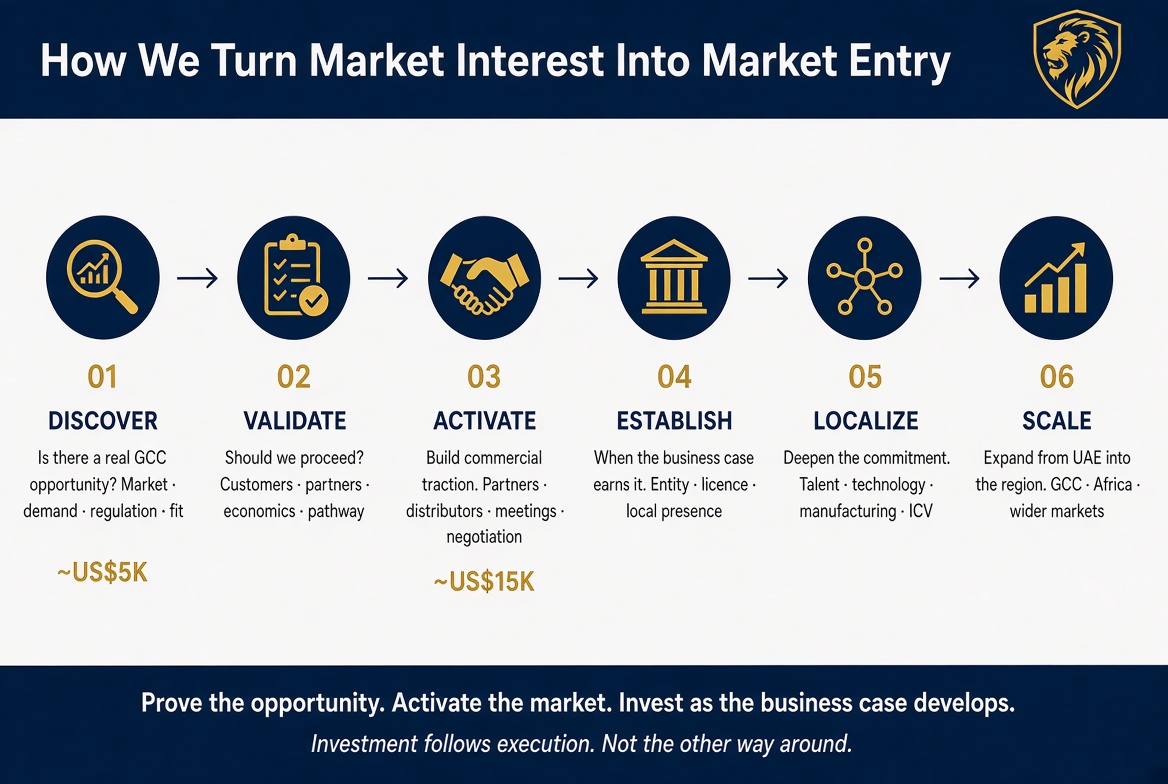
Anjo calls the method Services-Led FDI. It runs in six steps, always in the same order: discover, validate, activate, establish, localize, scale. First, 360Disruption checks whether there is a market, a buyer and a legal path. Then it opens the commercial side: customers, partners, distributors and the regulatory route. Only when that evidence exists does the company form a local entity, hire people, hold stock and think about a factory. "Before you start spending money," Anjo told us, "I already figured out for you whether you have a future. I defined the commercial pathway."
He puts it in one line: "Prove the market first. Spend the money after."
Customers first, licence later
One page on the 360Disruption site asks the question most newcomers ask: do we need a UAE licence before we have customers? The answer is one word: no. A company on paper, the page says, is not market entry. It is a cost.
Anjo is blunt about it. Setting up a company the classic way costs a few thousand US dollars. "And what do you do afterwards? Hope and pray that something will happen?" A trade licence, he says, is not market entry, "and that's where most people go wrong."
Without a local company, the site explains, a business can still appoint a distributor, run import approvals and product registrations through a partner, collect letters of intent, set up pilots and test its price with real buyers. The licence comes when there is a named distributor or a first commercial deal, and it is sized to what the evidence shows: a simple trading licence, a free zone company, a mainland company, or nothing yet.
The case files on the site show how this plays out. A US diagnostics company arrived with no UAE entity, no distributor and no clear regulatory route. 360Disruption mapped the rules and found a distributor before any decision to set up, and the company's own local base was put off until sales justify it. A US consumer health company got import approval and pharmacy and clinic channels, made its first sales, and only then started localizing its packaging. In both cases the factory question was left for later.
Anjo also tells clients when the answer is no. "If I figure out that there's no future for you, I will tell you there's no future for you in this country," he says. "It doesn't mean that your startup fails. But at least at that point you have saved a lot of money."
Not Apple, the thousands of smaller companies
Most investment promotion, Anjo says, chases giants. A country calls a company like Apple and offers land and buildings. But a giant has to stay competitive, so it puts its expensive work where labour is cheaper, and the country ends up with little more than a logo.
He goes after the rest. There are millions of small and medium companies, and he uses the German idea of one, which can still mean a company with billions of dollars in revenue. These companies want to grow abroad, and the UAE wants them. Its goal, Anjo says, is to be sovereign: to pull companies in from abroad and turn them into local companies. He is, among others, working with a Canadian health company right now to bring it to the UAE.
He works the other side of the table too. 360Disruption has written an investment blueprint for a UAE institutional entity, and it works with an emirate's chamber of commerce under a memorandum of understanding. Its site sets out programmes for chambers, embassies, free zones and investment agencies, to turn the interest they attract into companies that actually operate. "The Chamber attracts," the site says. "360Disruption executes."
From Palo Alto to SAP
Anjo spent most of his career in software, much of it in Palo Alto. In the late 2000s he chased a deal with SAP, the German business software giant, for about two years. SAP leaned towards working with IBM's Tivoli division instead, so he flew to New York to meet Tivoli, and talked to board members at HP as well. "We might be the smallest company," he remembers telling the people at SAP, "but I have worked all the hallways. I have worked all the basements where the developers are located, and they all love this."
He signed the OEM agreement with SAP. Anjo says the company's revenue quadrupled, and that SAP's own revenue built on the technology grew substantially. He left the company in 2014.
Three weeks later he was bored, so he started again. He built an automated pricing system with machine learning, won an official SAP partnership, and signed his first customers before the product was finished, among them a North Carolina company that made bolts and nuts for, among other things, the space shuttles. "A lot of these deals came through credibility, insight, respect and honesty," he says. When COVID arrived and a new investor wanted to run the company hands-on, Anjo stayed on the board and stepped back.
Looking back, he saw a pattern. For years he had been opening new countries for businesses, winning commercial traction in places he had never been. His About page says the method was first used building international operations for Redwood Software across Europe, the United Kingdom and the United States, then at the companies that followed. In hindsight, Anjo says, much of that was already Services-Led FDI: the company did not start by investing heavily in a new country, it first created commercial reasons for the investment to happen. 360Disruption turns that habit into a business. "It was not created simply to be disruptive for the sake of the name," he wrote to us. "I wanted to disrupt a process that I believe can be done considerably better."
Why Dubai
Anjo had been on every continent except the Middle East. After a few years in Florida, which he found beautiful but "way too slow," he made a bold move and moved to Dubai, a city he had only ever seen from its airport. That was about seven years ago. He still has a company in Chicago, which feeds clients to 360Disruption, and he splits his time between the two cities.
He does not sell the UAE as easy. "It's easy to talk to people in this country, but doing business is a total different story," he says. "It's all based on trust. It's all based on credibility, and that takes time." Collecting business cards is not a network. What counts is showing that you deliver, and knowing that decisions sit with the leader. Many newcomers, he says, believe the roads are paved with gold. "It's not true." Companies that arrive without credibility or a network often fail, and that gap is where 360Disruption works.
His view of startups is old-fashioned, and he says so. He does not believe in founders who have an idea and go straight out for funding. "Show me something first." He remembers pitching at one of Silicon Valley's best-known venture firms while his company was cash flow positive and making money, and being asked only one question, again and again: where is your double-digit growth? Too many startups today, he says, start sending pitch decks before they have revenue or traction, and many do not yet know where their market is. "The market might be somewhere totally elsewhere."
Where it sits
Many firms help companies land in the UAE. Virtuzone, Creative Zone and Shuraa Business Setup sell company formation, licences, visas and bank accounts, quickly and in volume. Employer-of-record companies such as Deel, Remote and Globalization Partners let a company hire people in a new country without opening an entity there. Big consulting firms write market studies for companies that can pay for them. While these providers primarily focus on establishing a company's presence or supporting its operations, 360Disruption takes a different starting point: determining whether a commercially viable opportunity exists before committing to a local establishment.
That is 360Disruption's corner. Its site lists what it will not do: no licence-first packages, no promise of investment, no shortcuts with government. "We do not sell access we do not have."
What they are looking for
360Disruption charges cash fees, not equity, and Anjo is open about the amounts. A typical discovery engagement costs about US$5,000. If the opportunity is strong enough, commercial activation costs about US$15,000, depending on scope. These figures serve as indicative benchmarks rather than rigid pricing packages. Depending on the nature of the opportunity, the company's circumstances and the scope of work required, 360Disruption may adapt its commercial arrangements to reflect the specific situation. That is where most of the work happens: finding partners and distributors, coordinating with regulators, setting up commercial meetings and negotiating, on the way to real revenue. Setting up a local company and any larger investment are scoped later, when the business case earns them. Anjo says the price works for bootstrapped startups as well as for larger companies, because spending a modest amount to prove a market can save a much larger amount spent on something that never sells. "Investment follows execution," he says. "Not the other way around."
- Companies with a product and an eye on the Gulf, from startups to established firms, in healthcare, manufacturing, technology, logistics, AI and sustainable infrastructure.
- North American and European companies that want to test the UAE, and the wider Gulf, before they commit money.
- Chambers of commerce, free zones and investment agencies that want the companies they attract to become operating businesses. Near Toronto, Anjo is already talking with chambers that offer land to companies looking for a new base.
Reach the team through 360disruption.com or hello@360disruption.com.
Why it is bigger than it sounds
This breed of company is very smart: it sells the answer before it sells the setup.
Most of the market entry business is paid to put a flag in the ground: the licence, the visa package, the office. The more flags, the more fees, whether or not anyone buys. 360Disruption is paid to find out first whether the flag belongs there at all. The company pays about US$5,000 for discovery, then about US$15,000 for a scoped programme that builds real evidence: a distributor, a regulatory route, a first sale. And the destination has a reason to pay too, because chambers and governments are judged on companies that operate, not on licences that sit idle. That puts 360Disruption on both sides of the table, and both sides want the same thing from it.
The formula: wherever a country is selling entry, sell proof instead. Charge for the evidence, then let the capital follow it. The same play fits Saudi Arabia, which is pulling regional headquarters to Riyadh, Japan and Korea, which want foreign startups but are hard to read from outside, Mexico for companies moving factories closer to the United States, Poland and Portugal for companies entering Europe, Kenya, Nigeria and Rwanda for Africa, and Canada's own smaller cities, which compete hard for companies to move in.
The risk in one line: a firm that tells clients to wait earns less per client than one that sells the licence, so it has to win on trust, and in the UAE trust takes years. If you run a North American startup or a growing company and the Gulf is on your list, talk first to someone who will tell you not to buy the licence yet.
What to watch
The first thing is the institutions. If more chambers, free zones and investment agencies hand their incoming companies to an execution desk like this one, the model stops being a consultancy and becomes part of how the UAE attracts investment.
The second is Canada. Anjo's talks with chambers near Toronto could turn the same method into a corridor between Canada and the Gulf, in both directions.
The third is startups. Anjo wants to go deeper with young companies, and a version of the method built for startups would test whether proving the market first works as well for a ten-person team as it does for a mid-sized manufacturer.