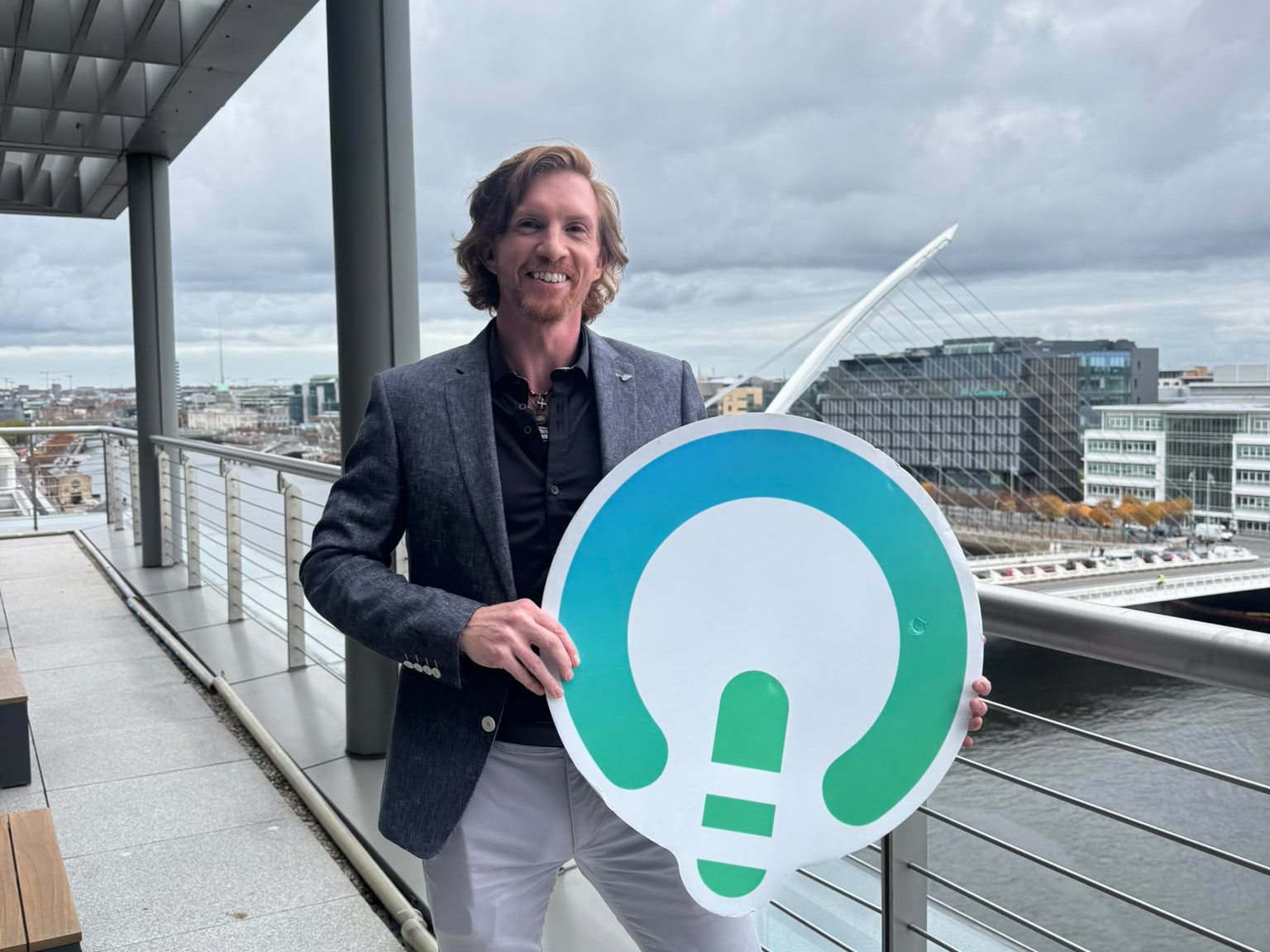
Almost every AI built for mental health plays the therapist. You type your worries, and it answers. Ian Boyle built the other side of the room. His AI plays the client: a person with a past, with fears, and with things it will not say until you earn them.
The people who talk to it are the ones who have to get those conversations right. Therapists in training before their first real client. Volunteers on a crisis line before a caller who is thinking about suicide. Parents before a difficult talk with their own child. They practise on the AI first, so they are not practising on a real person.
What they built
ClinRehearse, made by Ian's company Wired by Nature in Dublin, Ireland, calls itself "the flight simulator for high-stakes conversations". Nobody would fly with a pilot who never trained in a simulator. Ian asks why we accept it for the person on the other end of a crisis line.
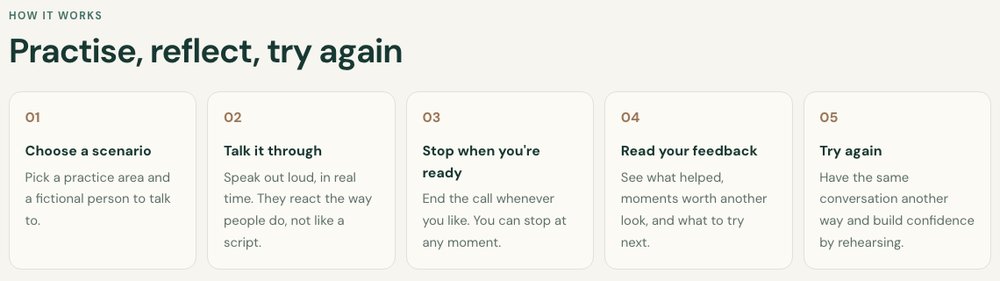
Here is how it works. You pick a practice area and a fictional client. Then you speak out loud, in real time, as you would in a session or on a call. In the therapy version, the client arrives the way a real one does, with intake and health forms and the standard questionnaires for depression and anxiety, and you can run the session guided or unguided. The person on the other end is played by AI, and the website says it has "their own story and feelings, which come out as the conversation goes, depending on how you listen and respond." You can stop at any moment. When the session ends, an AI coach reviews the conversation and tells you what went well, what you missed and another way to approach it. Then you go back in and try the new approach. Every session is saved, so you can pick it up later, download it or share it with a tutor or team leader.
Ian is clear about where it fits. ClinRehearse adds to formal training, supervised role-play and placement. It does not replace them. It is a place to rehearse, get feedback and try another approach.
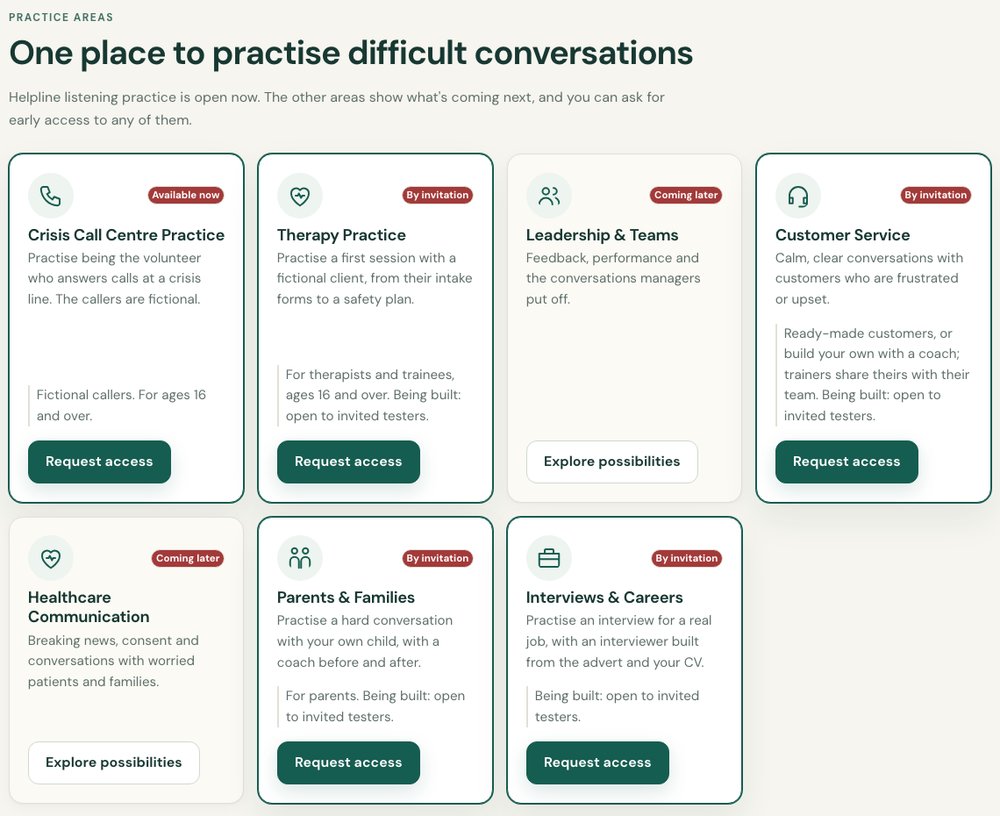
The first area open to users is Crisis Call Centre Practice, where you are the volunteer who answers calls at a crisis line and the callers are fictional. Therapy Practice is open to invited testers, and so are Customer Service, Parents & Families, and Interviews & Careers. Leadership and healthcare conversations are coming later. ClinRehearse is in private beta, and you get in with an invite code. With one switch, Ian says, the whole app can run in another language: the clients, the coach and the voice conversations. The site says practice calls are private to the user and deleted after 30 days.
An engineer in the therapy room
Ian did not start in psychology. His engineering career goes back about 20 years. He studied robotics and holds a degree in mechatronics, then spent years on circuit boards and later on car electrics. He built his own automotive engineering business.
That business taught him something no course did. Customers came to him with a technical fault, but often the real weight was money pressure and stress. So while he fixed the fault, he was also managing how they saw their own lives. "Most of my job then was not just solving the problem that they came with," he says, "but also satisfying their perception that everything was going to be okay."
About ten years ago he followed that curiosity into psychology, first through mindfulness and counselling, then into cognitive behavioural therapy, or CBT, combined with hypnosis. Today he is a qualified cognitive behavioural hypnotherapist, with a Level 5 Diploma in Cognitive Behavioural Therapy and Hypnotherapy and a Diploma in the Psychology of Counselling. He sees clients in Dublin and online, and he works alongside a psychotherapist adviser. He is still director of his automotive business, but it is managed day to day, so his time goes on ClinRehearse and a few clients. His therapy website puts his approach in one line: "Understand the pattern. Practise the change."

No simulator, no rewind
ClinRehearse began as a tool for Ian alone. As a therapist he started to meet the hardest kind of moment: a client who suddenly discloses something very sensitive, or a person in deep distress. He saw that many therapists are underprepared for it. Crisis lines face the same thing when a caller talks about suicide, a subject people tend to shy away from. "I know CBT," he says. "I know how to structure someone's patterns and help them break them up." But a person in a very delicate place, he says, takes a different set of skills.
Training does not fix this, and his pitch deck shows why. Counselling courses in Ireland require 120 hours with real clients on placement before a trainee qualifies. Before that placement, trainees practise on their classmates, who know the script, so they rarely meet real distress. One tutor cannot watch every attempt, and the supervisor is not in the room. So the first time a trainee has to ask a client whether they are thinking about ending their life, it is with a real person. Ian sums it up as "no simulator, no rewind."
So he tried to practise on his own. He set up ChatGPT in voice mode, told it to be his client, and talked to it. It did not work. "The problem with normal AIs is that they want to tell you the answers and they want to please," he says. Real people are not like that. They rarely respond in straight lines. Past experiences, fears and memories shape how they react, sometimes in ways they do not fully understand themselves.
That is where the engineer took over. Ian wanted an AI with unusual limits: one that knows less, not more. "I wasn't actually producing it for anyone," he says. "I was making this so I could be a better therapist." Then other people started to find it interesting, and the tool became a company.
Fast mouth, slow mind
Ian calls his engine FMSM, short for fast mouth, slow mind. The mouth is a fast AI model that speaks in character, in real time. The mind is a slower reasoning model that sits behind it, and you never hear it. It thinks while you are still talking, between turns. It holds the client's unspoken thoughts, its core values and its opinion of you.
Each client is built from a life of memories, and each memory carries its own fears and emotions. As you talk, that hidden mind narrates to the client the memories your words have stirred up. When a painful memory comes up, the client's mood shifts. You do not know which memory it was. You only see the change, the way a therapist only sees the change in a real person. Ian compares building it to a Rubik's Cube. In his deck he puts the result in one line: the client "opens up only when you earn it."
So the client does not know the answer to its own problem. "This thing that you're talking to doesn't know the answers," Ian says. You cannot wait it out. You have to be curious, ask questions, show empathy and help it connect its memories to its patterns.
The coach is a separate part of the system. The slow mind is the client's silent inner voice, and it shapes what the client says. The coach comes in afterwards and reviews the conversation. It matters as much as the client. Ian's deck cites a 2025 randomised study, still a preprint, of 94 novice counsellors: those who practised with an AI client alone did not improve, and those who also got structured feedback did. "Feedback is the multiplier," the slide says.
The same engine works outside therapy. When someone asked Ian about customer service, he built an angry customer. A job was done for him, something went wrong the next day, and he is furious. The hidden layer knows why: he cannot afford the real repair, and he is too proud to say so. To calm him down, the trainee has to find that fear and make room for it. Ian calls it "a psychological tug of war." For parents, it works the other way round. A parent describes their child's behaviour, and ClinRehearse tries to build a child AI from that description, so the parent can try different approaches before the real talk.
Ian says the point is not to replace people with AI. It is the opposite. "I'm trying to help people develop their own communication skills so they can talk to other humans more," he says.
Where it sits
Most AI in mental health serves either the person in distress or the clinician's paperwork. Woebot Health has built chat-based AI wellness tools since 2017, and Wysa lets people vent and talk through negative thoughts and emotions. Limbic sells clinical AI to mental healthcare providers, and Eleos builds AI for community-based care organisations. Closer to training, Lyssn uses research-backed AI for training and quality improvement in health and human services, and says it is trusted by over 100 behavioural health and crisis care organisations. mpathic has clinicians play a wide range of patients to stress-test AI models for safety. ReflexAI builds AI simulations, role-play and automated quality checks for contact centres. SimConverse in Sydney uses generative AI to play any patient, colleague or casualty for health students, and Oscer builds virtual patients for practising diagnosis. Bodyswaps in London lets students practise job interviews and difficult conversations with immersive AI roleplays. In sales, Yoodli in Seattle, Second Nature and Hyperbound sell AI role-play to train sales teams.
The chatbots give answers to the person who is struggling. The role-play tools mostly train people to sell, or score a conversation after it has happened. None of them describes what ClinRehearse is built around: a client with a hidden second mind, carrying memories it does not fully understand itself, built by a working therapist from the hardest moments of his own practice.
What they are looking for
ClinRehearse is not raising money yet. Ian is the sole founder, and he has built and paid for everything himself. A small group of practitioners, helpline testers and staff in Ian's own business are testing it in private beta, and he is talking to helplines, training bodies and businesses about pilots. He was shortlisted for the 2026 National Startup Awards in the MedTech Startup category for Dublin, and pitched at the finals. He did not win, but says he was very happy to be part of the evening. He has also applied for the next phase of a government-backed founder programme in Ireland and expects an answer within a month or two.
ClinRehearse is in private beta, and Ian is exploring subscription and usage-based pricing for training organisations and businesses. His focus is on validating customer demand and building a sustainable commercial model before he introduces paid subscriptions. His deck sizes the first market at about 340,000 therapy trainees and helpline volunteers across Ireland, the UK, the US and other English-speaking countries, worth about €81.6 million a year, with about 65,000 of them in Irish and UK programmes and helplines he can reach now. These are his own estimates. By April 2027 he aims to have 1 to 3 colleges or training bodies and 2 to 6 businesses as customers, with clients built from a course's own case material.
He is clear about what he lacks. "My biggest gap is commercial sales experience," he told us. His natural state, in his words, is "see a problem, solve a problem." From North American readers, ClinRehearse wants:
- Sales expertise: mentors who have sold training or health software and can help him win the first institutional customers.
- Pilot partners: counselling and psychotherapy schools, crisis lines and helplines, and businesses that train staff for hard conversations with customers.
- Testers: therapists and trainees, crisis-line volunteers and trainers, customer service trainers and parents, in any language.
To request an invite code, or to talk to Ian, email ian@wiredbynature.ie with your name and the areas you would like to try.
Why it is bigger than it sounds
This breed of startup is very smart: it flips the AI around. Everyone else builds the AI that knows the answer. ClinRehearse builds the AI that has the problem, and sells the practice to the person whose job is to solve it.
That changes who pays and what can go wrong. A therapy chatbot talks to a person in distress, so every mistake lands on a vulnerable person. A practice client talks to a trained adult who chose to be there, so a mistake costs nothing but a second try. The money comes from training budgets that already exist: counselling schools that must prepare trainees for placement, crisis lines that train thousands of volunteers, firms that train staff to handle angry customers. Today that practice needs a classmate, a tutor or a paid actor, and a fixed time. An AI client works at any hour and in any language, and runs the same hard call as many times as you want. Each new client is a new product on the same engine. Investors already pay for this category in sales: Yoodli says it has raised $40 million in a Series B.
The formula: build the AI that plays the difficult person, give it a hidden story it does not reveal, and sell rehearsal to people whose mistakes are expensive. The same play fits doctors and nurses breaking bad news, police officers learning to calm a person in crisis, social workers on a first home visit, teachers before a hard meeting with parents, managers handing out layoffs, debt collectors, airline cabin crew facing a disruptive passenger, and lawyers preparing a witness. It fits countries too. South Korea and Japan both run national suicide prevention lines, and every listener on them has to be trained in their own language. The big call centre industries of India, the Philippines and South Africa train thousands of new staff for angry customers every year. Whoever builds the most believable difficult person first can sell it to every one of them.
The risk in one line: the whole product rests on the client feeling real, and Ian is one engineer with no salesperson yet. If you train counsellors or crisis-line volunteers, run a contact centre, or back pre-seed founders who build first and sell second, this is a founder to call.
What to watch
The first is the first college or training body to sign. Ian's plan has 1 to 3 of them by April 2027, using clients built from their own case material. One signed course would show that schools will pay for practice before placement.
The second is the commercial side. Ian says sales is his biggest gap. A sales partner or a commercial co-founder would tell us the company is moving from a working engine to a business. This is our opinion, not something Ian told us.