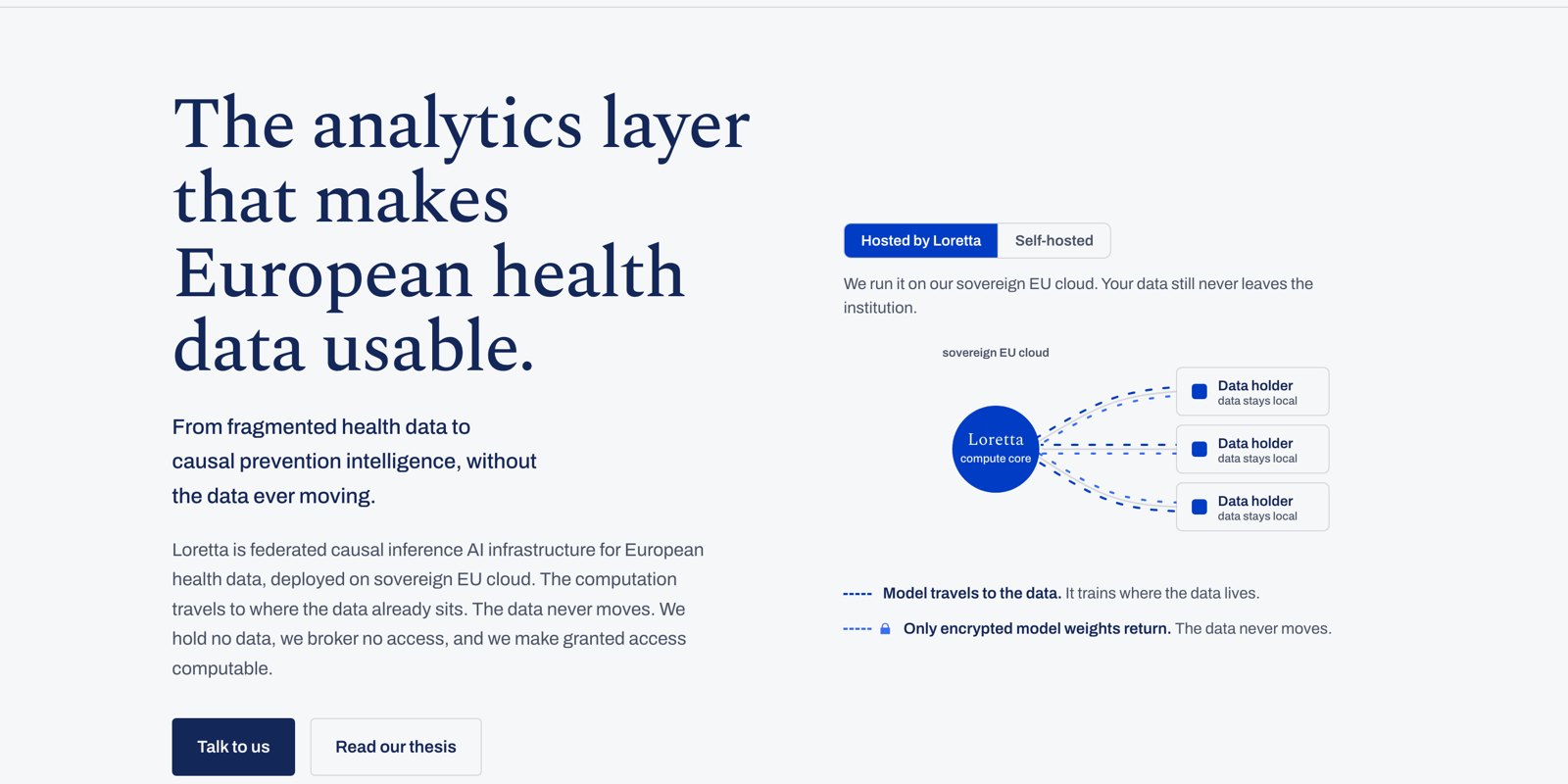
Europe has a strange problem with its health data. The records exist. New European rules are making it legal to use them for research and prevention. But the records sit in separate hospitals, insurers and research groups, and the law makes it very hard to pull them into one place. So the data is there, the permission is coming, and, Loretta says, that access still produces no insight.
Daniel Townsend's answer, from Berlin, is to stop trying to move the data. "Our models travel to the data," the founder told us. "We never need to hold your data."
What they built
Loretta calls itself the analytics layer for European health data. It helps a health system, an insurer or a research group find out what is really going on across its records, without anyone handing those records over.
Patient information is usually locked in silos, behind laws that limit who may hold it. So Loretta sends its model to whoever holds the data. The model does its work there, then leaves, taking only encrypted numbers called model weights. The records stay where they were. "If I tell you how it works, I would give my secret sauce," Daniel says, but that is the idea, and the technical name for it is federated learning. The website puts it in one line: "We hold no data, we broker no access, and we make granted access computable."
Because the model can visit many sites, it can learn across data sets that could never legally sit together. "I don't like this term," Daniel says, and then offers it anyway to give a sense of the idea: a "decentralized Palantir." Palantir, the US data company, pulls many sources into one massive data set and draws its insight from that. Loretta looks for the same kind of insight and never builds the pile.
Four layers
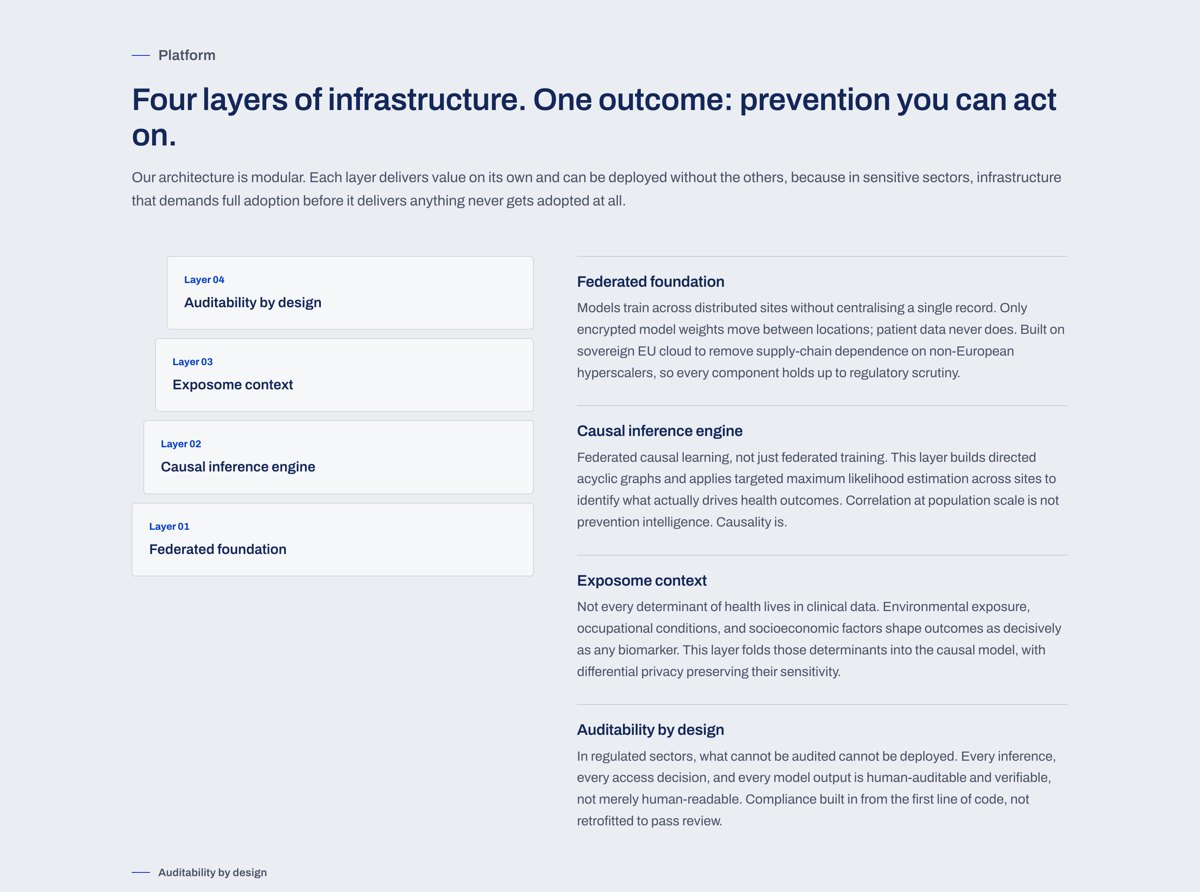
Loretta is built in four layers. A customer can start with any one of them, because in sensitive sectors, the website says, infrastructure that demands full adoption before it delivers anything "never gets adopted at all."
- The federated foundation. Models train across sites without gathering a single record in one place. Loretta can run this on STACKIT, the European cloud of Schwarz Group, the German owner of Lidl and Kaufland, or inside the customer's own systems, with the customer holding the keys.
- Causality. Most health analytics tell you who is at risk. Loretta wants to tell you what would change the outcome, for whom. "Others federate," the website says. "We federate and explain why."
- The exposome. This is Daniel's word for "everything that is extraneous to a person": the invisible factors, such as the environment, working conditions and money, that shape health as much as any blood test. Loretta's website lists Fraunhofer HHI, the German research institute, as its research partner on this layer.
- Auditability. Every access decision and every output goes into a trail that shows if anyone has changed it. "In regulated sectors, what cannot be audited cannot be deployed," the site says.
Not only a patient story
Loretta does not try to change what happens in the doctor's office. "We're not trying to get doctors to do stuff differently," Daniel says. "It's not a patient-only story." The customer is the whole system, and the product is intelligence for designing it better. The website's target is chronic disease prevention: "what makes people ill, and what can be changed before they become ill."
That leads to very different jobs. Loretta was recently asked to help a health system plan for surges in demand caused by weather events. It works with diabetes data to understand what patients need and are not getting. It helps with system design inside a hospital, and it does modelling for large institutions. "We do hardcore science," Daniel says.
From Ottawa to Berlin
Daniel is Canadian, from Ottawa, and studied at Queen's University and the University of Toronto, where the PhD came from. The career that followed was all policy. As a senior analyst and planner at Ontario Health, Daniel worked on the design of the province's kidney care system, including consulting First Nations and Aboriginal communities on expanding care. "I was never in a hospital," Daniel says. The work was the design of the system, not the delivery of care. Then came policy advice for the Canadian government, healthcare consulting, and the Global Fund in Geneva.
One question ran through all of it: how do you get care to the people who need it most, when they are often the ones the system serves worst? Daniel calls that "really truly a north star" of the career. People end up where they are because of many factors in their lives, which health workers call the determinants of health. Policy could describe those factors well. It could not move fast. "I was beginning to get a little bit more frustrated with the pace of change," Daniel says. "I wanted to move away from abstracting policy and design to something that's more tangible."
That became Loretta, and Germany became home: Daniel wanted to be out of Canada for a bit, and it has been a while now. The first idea was narrow: what does a doctor need to know at the moment of seeing a patient? "Medicine is often what you can see and observe and measure when the person shows up in front of you," Daniel says, and a great deal happens before and after that moment. Several pivots later, the company serves the system and not the single visit. The first concern stayed. Fairness, the website says, is built into the model itself and not added as a check afterwards.
Slowly, on purpose
Daniel is the only founder. The team is about a dozen people, with its headquarters in Berlin and an office in London, where Loretta is part of the NHS Innovation Hub. "Just the right size," Daniel says, and it does not want to grow much bigger for now. So far the money has come from the Berlin government and from angel investors.
That was deliberate. Daniel wanted the technology built before any venture money arrived, so that outside money would go into scaling the business and not into paying for development. The website has the same patience. "Healthcare is painstaking," it says. "We are not here to disrupt. We are here to build." Loretta is a voting member of sphin-X, a German association setting standards for health data infrastructure, and it designs its product alongside the new European rules, not after them.
Where it sits
Sending the computation to the data is a growing idea in health. Lifebit in London sells federated research environments. Owkin used federated learning early on for medical research. Apheris, also in Berlin, applies it to drug discovery models. Tune Insight in Lausanne connects hospital data across Europe without the data leaving the hospital. Rhino Federated Computing in Boston, Bitfount in London and Aridhia in Scotland all offer ways to work on sensitive data where it sits. And Palantir is the big name that takes the opposite road.
Most of these tools answer "what does the data show?" Loretta's claim is that none of them pairs privacy-preserving federation with causal analysis for preventing chronic disease, without ever taking custody of the data.
What they are looking for
Loretta is actively looking for investors. It will need an institutional round eventually, and it wants that money to scale the business, not to pay for developing the technology.
- Investors in health and data infrastructure who want to fund scaling, not research.
- Health systems, insurers and public health bodies that hold data they cannot use, and want to run causal models without letting it leave.
- Research groups and institutions that want to join a federated study or help shape the standards.
- Canadian health organisations that want sovereign, compliant data systems. Daniel is already talking with several.
Reach Daniel at dtownsend@loretta.care or through loretta.care.
Why it is bigger than it sounds
This breed of startup is very smart: it wins the hardest argument in health data by never having it.
Every health data company has to ask an institution for the one thing it least wants to give: the records. That request brings lawyers, ethics boards and years of delay. Loretta does not make it. It sends the calculation, keeps nothing, and leaves a trail anyone can check, so the sale stops being about trust in Loretta and becomes a question of whether the answer is worth paying for. The money sits with the organisations that already have the right to the data and cannot use it: health systems, insurers, drug companies and public health bodies. The more European rules open up access, the more of them need this layer. And a company that holds no data has very little that can be stolen.
The formula: where data is too sensitive to move, stop trying to move it. Send the question to the data, bring back only the answer, and build on your own country's cloud. The same play fits banks that want to spot fraud together without sharing customers, insurers, tax and customs agencies, schools and student records, factories that will not show their numbers to a rival, power grids, and defence. It also fits any country that wants its records on its own soil, from Canada to Japan and Korea, India and the Gulf states.
The risk in one line: health systems buy slowly, and a small team has to outlast the sales cycle. If you invest in health or data infrastructure, or you run an institution sitting on records you cannot use, this is a team to call.
What to watch
The first thing is the round, and who leads it.
The second is Canada. Canadian health organisations want systems of their own, not built on Google or Amazon, and Daniel knows that system from the inside. A first Canadian project would make Loretta a company that travels.
The third is Europe's rules. As the European Health Data Space comes into force, watch whether the institutions that gain access to data choose a layer like this one, or build their own.