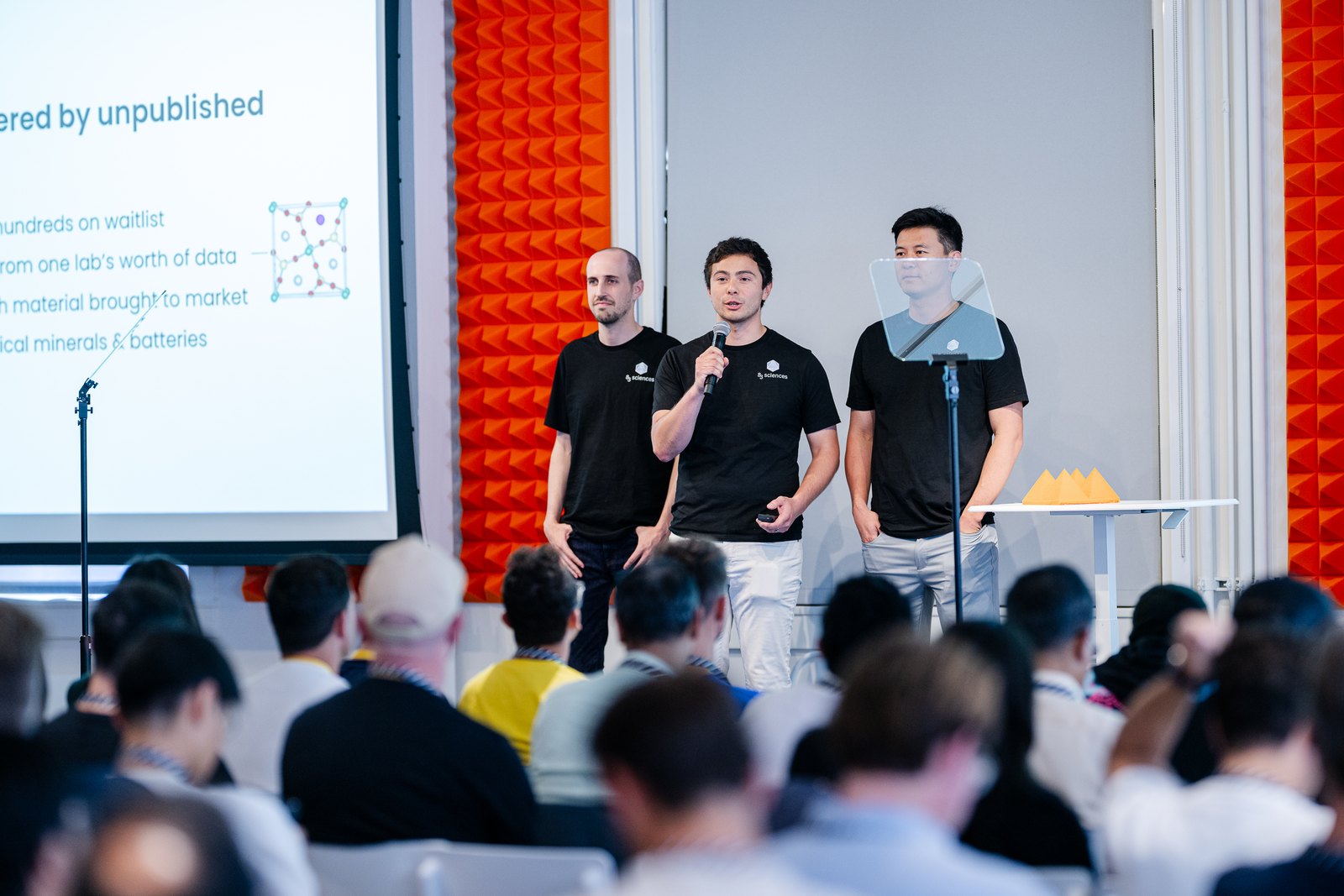
A chemistry PhD takes years of experiments. By Ian Naccarella's count, maybe 10% of that work ends up in a published paper, and it is the 10% that was cleaned up and gave the result the student was looking for. The other 90% goes into an archive in the lab. Nobody shares it. Nobody labels it. After a few years, nobody remembers it is there.
Ian thinks that forgotten 90% is worth a lot. His company, 83 Sciences, collects it from university labs and uses it to teach AI how to invent new materials. The first target is magnets.
What they built
83 Sciences, based in New York, works with academic labs to turn their unpublished experimental data into something a computer can learn from. "There's tremendous value in experiments that went wrong in an interesting or unexpected way," Ian, its CEO and co-founder, told us. Even plain repeats are useful, he says, because they still show which conditions in a reaction lead to which product.
The hard part is that nobody writes up a failure. If an experiment does not give a good result, the PhD student does not label it or go back to ask why. So 83 Sciences works with the lab to do exactly that: it prompts the people who ran the experiments to put the data into a clean, structured format. Then it uses that data to train AI models that look for new materials.
The AI part has two layers. 83 Sciences takes open-source models and trains them further on real experimental data, because, Ian says, today's models are not good enough for true materials discovery. Some of the models are large language models, the kind behind chatbots, and many are not. In the middle sits one language model that acts as a coordinator and can call a whole set of tools. The team trains both the coordinator and many of the tools it uses.
The company's website lists four areas of work: magnetic materials, materials for extracting critical minerals, materials for packaging semiconductors, and training environments for materials science AI built on real experimental data.

Why AI keeps inventing materials that cannot exist
Ian explains the problem with pictures of dogs. To build an AI that makes images, you train it on millions of pictures of dogs. It learns how to turn a picture into pure random noise, and then how to run that in reverse, so it can make a new dog out of noise.
Materials discovery works the same way. You train a model on databases of millions of materials and their properties. Then someone asks for a material with a certain conductivity and certain other properties, and the model suggests candidates. The trouble, Ian says, is that the model knows what a material should look like but has little sense of the chemistry underneath. So it proposes materials that look real but are not stable, or cannot be made at all.
The usual check is a computer simulation based on quantum physics. Those simulations have error bars, Ian says, and they are not precise enough unless you spend huge amounts of computing power. The fix is real data from real experiments, so the model can compare a new idea with materials that people have actually made. "It's a well-understood problem that generative models right now lack experimental data," he says. Many teams are working on how to get that data. Most of them are building it from scratch.
Old data instead of new robots
The popular answer is the self-driving lab: a fully robotic lab where machines run experiments day and night and produce large amounts of repeatable data. 83 Sciences does the opposite. It goes to academic groups and says, in Ian's words: "You've got 15 to 20 years of old experimental data sitting on your shelves gathering dust. What if we brought that in to train the model?" No robot arms. The labs already did the work.
In the early days the deal is a sponsored research agreement, a contract universities already know how to sign. The money goes to a PhD student or a postdoctoral researcher who works with 83 Sciences to structure the data. In return, 83 Sciences gets the right to use it. Later, Ian says, labs will be paid by what their data turns out to be worth. If it is packaged into a training environment for AI or sold to a frontier AI lab, the labs that supplied it get a share of that revenue.
Ian is open about where the company stands. He calls it "midway through proving it." The team has shown, with one electrochemical dataset, that unpublished data can be structured well enough to train a model to predict the properties of a material. That works in one or two cases, not yet across every field. The second thing to prove is scale. Today the process still needs a lot of human hands, and Ian says it has to be about 99% automatic before it can run across many labs.
Why magnets first
There is a big push in the United States, Ian says, for new magnetic materials that do not depend on a supply chain based in China. The breakthrough magnet, made of neodymium, iron and boron, was invented in the United States and became the standard. Then the US sold that business to China. Since then, he says, there has been little new. These are the strong magnets inside electric motors, wind turbines and phones.
There is a second reason, and it comes from Ian's own career. Before 83 Sciences he worked in the battery industry, and he saw what kills new materials: qualification, the long testing a buyer demands before it will use something new. At the battery startup where he worked, he says, a new material took a couple of years to develop and then about five years of testing with electric carmakers. Magnets have many small niches where testing and manufacturing move much faster. A team can make a new material, measure it at different temperatures and conditions, prove it stays magnetic, and get it into production quickly. That is a faster feedback loop for a young company.
Magnets are the start, not the limit. The team has also looked at mining. Every mine's ore is different, and it changes over the life of the mine, yet mines run the same fixed process. With AI, Ian says, you can tune the chemicals used to pull the metal out for one specific body of ore. Mining earns lower margins than magnets, which is why it is not first. In the long run, he says, the same method can work for almost anything in the physical sciences, and in most of those fields the academic data is highly relevant.
A magnet chemist, a battery engineer and an AI rollout
There are three co-founders, and all three work full time. Ian studied chemical engineering at Stanford, worked at BCG, the Boston Consulting Group, then at a battery startup, and then went to Harvard Business School. His team page lists catalysis and battery materials at Stanford and at Sila Nanotechnologies.
Dr. Eric Riesel, the CTO, studied at Columbia and earned his PhD in chemistry at MIT, where much of his work was on AI for finding and describing new quantum materials. Magnets are already on his record. The company's publications page lists him as co-first author of "MnBi₂ Is a Permanent Magnet" in the Journal of the American Chemical Society in 2025, and as an author of a paper on predicted ferromagnetism in newly found cobalt and bismuth compounds the same year. Ian and Eric are both authors of a 2026 preprint on an agentic AI workflow for running many synthesis experiments.

Yankang Yang, the COO, started at BCG at the same time as Ian and stayed. By the end, Ian says, Yankang was leading BCG's AI programme, rolling out generative AI inside the firm. The team page also lists Yankang's work on robotics and cellular biosignalling at Harvard's Wyss Institute and at Roswell Park.

The company lists three advisors: Simon Billinge, professor and director of the CNSI at UC Santa Barbara; Mingda Li, associate professor at MIT; and Ashwin Sreenivas, co-founder and CTO of Decagon. 83 Sciences was in Y Combinator's Summer 2026 batch. It started in San Francisco and then moved to New York, because it works so closely with academic labs in New York and Boston.
Where it sits
Most of the field, Ian says, is building self-driving labs to make new data. Periodic Labs calls itself an AI research and deployment company building models and autonomous labs to speed up science. LILA uses AI and autonomous labs to form ideas, design and run experiments and learn from the results as they come in. Radical AI sends AI-designed experiments straight to its own self-driving lab, and Atinary, which calls itself a pioneer of self-driving labs, has opened one of its own in Boston. Dunia is building what it calls a materials acceleration platform. Others sell the software. Citrine Informatics makes an AI platform for developing chemicals and materials, Mat3ra runs a cloud for materials simulation, Orbital Industries sells CurieOS, an AI workspace for science and engineering teams, and CuspAI in Cambridge, England, runs an AI materials foundry with industry, lab and data partners. Aionics uses computing to design materials for clean energy, and Mitra Chem uses AI to develop and make materials for energy, AI and defence. On the magnet side, Niron Magnetics makes permanent magnets from iron nitride with no rare earths, MatNex designs critical materials to a buyer's specification, and Noveon Magnetics and Vulcan Elements make rare earth magnets in the United States.
The robot labs make fresh data, one experiment at a time. The software companies work with the data their customers already have. The magnet makers sell magnets. What none of them does is go to university labs, pay a small fee for the 15 to 20 years of failed and unpublished experiments already sitting on the shelves, and turn that forgotten work into training data for AI.
What they are looking for
83 Sciences wants two things from North American readers:
- First customers. Companies that need new magnetic materials. And anyone who wants access to real experimental data, especially frontier AI labs that need it to make their models better.
- Investors for its next round, which the company expects to raise in the next six to seven months.
The money already raised, together with OpenAI and Anthropic computing credits that came through Y Combinator, pays mostly for salaries and computing, because the work today is simulation. The next round has a different job. Once the team proves it can design a new magnetic material, it needs a bigger lab to take that material out of the computer and into real production. Reach Ian at ian@83sciences.ai.
Why it is bigger than it sounds
This breed of startup is very smart: it does not make new data, it rescues data that was already paid for and then thrown away. Scientists throw away about 90% of what they learn in the lab, the experiments that "failed" or never made the paper. 83 Sciences rescues that hidden data and uses it to teach AI to invent new materials, starting with the magnets the US no longer wants to buy from China.
Follow the money. Every one of those shelved experiments was already paid for, in lab money and in years of a PhD student's life. 83 Sciences opens a lab's archive with a small sponsored research agreement. A self-driving lab has to buy robot arms and run every experiment from scratch. Then the same data earns money more than once. It trains 83 Sciences' own models to find new magnets the company can bring to market. It can be sold to frontier AI labs that are short of real experimental data. And it can be packaged into training environments for materials AI. The labs that gave the data get a share of that revenue, so every new lab has a reason to say yes, and every lab that says yes makes the models better.
The formula: find knowledge that was paid for once and then thrown away because it did not fit the format, pay the owner a little to put it in order, and give the owner a share of what it earns later. The same play fits drug companies, whose failed compounds and stopped trials hold years of chemistry no one reads again. It fits oil, gas and mining companies, which keep drill cores and test results from wells and mines that never paid off. It fits battery makers and chip factories, which log every cell and wafer that failed testing. It fits farm research stations with decades of crop trials that did not work, carmakers with crash tests that never made the brochure, and hospitals with studies that found nothing and were never published. It fits countries too. Japan, Korea, Germany, the UK and India all have universities with decades of chemistry and physics sitting in their own archives. Whoever reaches those shelves first owns data that nobody else can buy.
The risk in one line: the method is proven in only one or two cases and still needs a lot of hand work, and it has to become about 99% automatic before it can run across hundreds of labs. If you need new magnetic materials, run an AI lab that is short of real experimental data, lead a university lab with years of unpublished work on its shelves, or invest in cutting America's dependence on Chinese magnets, this is a team to call.
What to watch
The first thing is the first new magnet. Today the magnet work is simulation. A material that the team designs, makes and proves stays magnetic in a real lab would show the whole method works.
The second is the next round, expected in the next six to seven months. Who leads it, and how big a lab it pays for, will show how fast 83 Sciences can move from the computer to production.
The third is the first frontier AI lab that pays for the data. That would prove the old experiments are worth money on their own, and it would trigger the first revenue share back to the university labs. This is our opinion: that moment matters more than any single magnet, because it turns every lab archive in the world into a possible supplier.