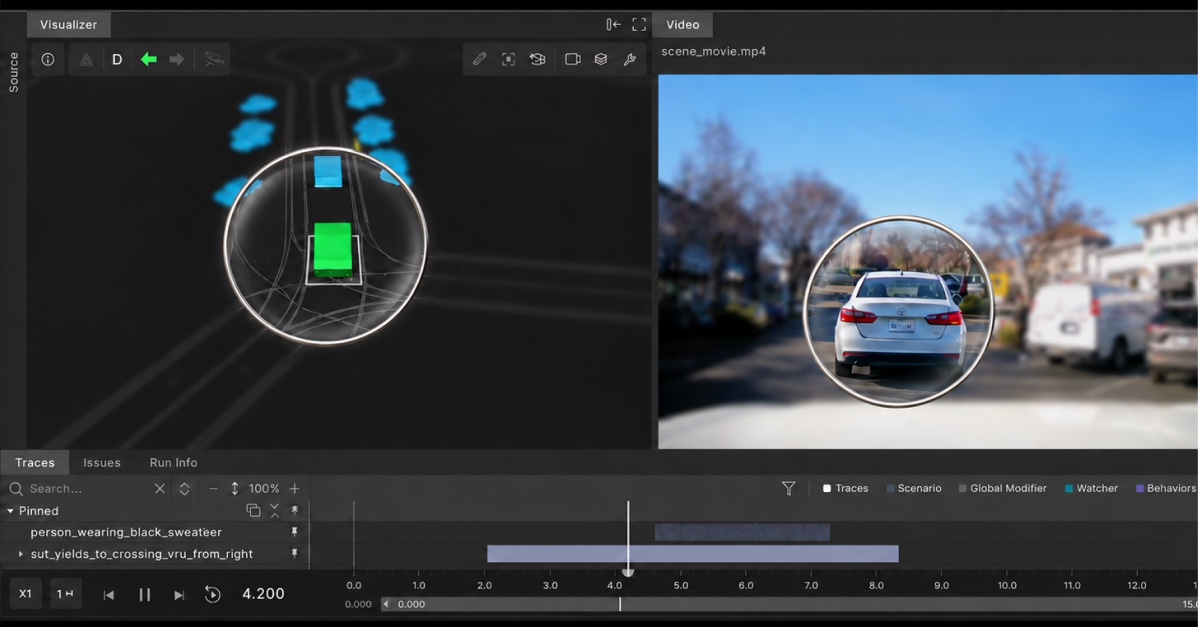
A computer chip cannot be patched once it is made. If a bug slips through, the company throws away the chips and starts again, at enormous cost. So the chip industry developed a method called coverage-driven verification. It does not just run more tests in simulation. It measures how much of the design has been tested and how much has not, then aims new tests at the gaps.
The founders of Foretellix spent their careers building that kind of testing for the most complex chips in the world. Then they asked where else the same discipline was needed. The answer was a car with no driver.
What they built
Foretellix makes software for testing self-driving cars before they reach the road. Its product, Foretify, is what the company calls a physical AI toolchain. It takes real driving data, finds the situations that matter in it, creates new synthetic scenarios to fill the gaps, and checks how safely the car's software behaves in each of them. It is coverage-driven verification, the method from chips, applied to driving: not just to test a lot, but to know what has been tested and what is still missing.
The customers build self-driving cars, trucks and mining vehicles, and the driver-assistance systems in ordinary cars. Foretellix's website carries testimonials from NVIDIA, the self-driving truck company Torc, Woven by Toyota and Mazda. In October 2026 it announced that it is working with NVIDIA's Halos safety system for self-driving cars.
From chips to cars
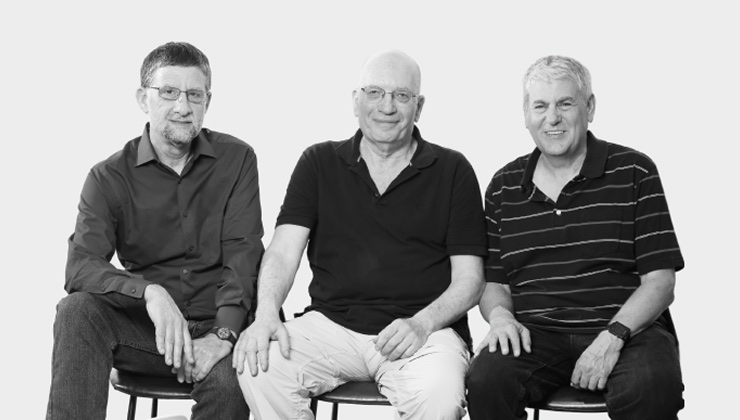
Ziv Binyamini, the CEO and a co-founder, started his career at Intel, in Israel and in Portland, Oregon, testing big processors in simulation. He then joined Verisity, an Israeli startup that, Ziv says, invented coverage-driven verification and changed how chip companies check their designs for bugs. "Almost every company that's doing complex chips," Ziv told us, uses the methods Verisity brought to market as one of its main ways of testing. Verisity went public and was then bought by Cadence Design Systems in Silicon Valley, where Ziv went on to run its simulation business.
Verisity's founder was Yoav Hollander. The two met through a headhunter's call. Ziv told the headhunter he was happy at Intel but willing to talk, and Yoav phoned him the next day. They have spoken almost every day since. Yoav later left Cadence to look for other places their technology could go. When he landed on self-driving cars, Ziv joined him. "That sounds like a good enough interesting challenge," Ziv remembers thinking.
The third co-founder, Gil Amid, worked with Ziv at Intel. They were on the same team in Portland, and neighbours. Gil is now the chief regulatory affairs officer.
Yoav is the CTO. He was the founder of Verisity too, but he never wanted to manage, so this time Ziv became CEO. "Not my initial intent," Ziv says, "but that's where I ended."
Right vision, slow road
The idea was simple. Chips and self-driving cars are both extremely complex, and in both the cost of failure is extremely high. "It's a car moving fast," Ziv says, "and if it makes the tiniest mistake, it can cause harm to people."
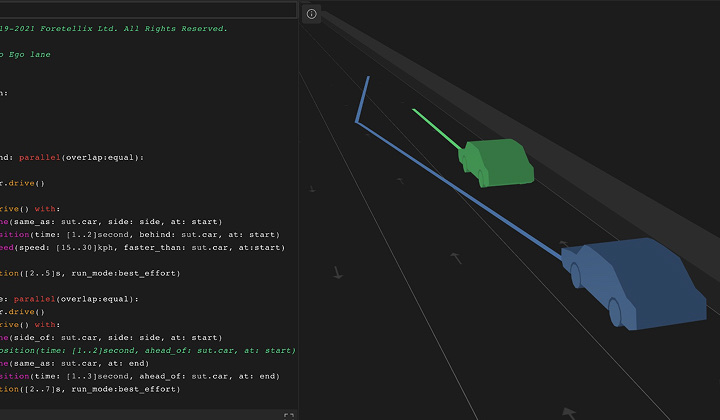
Foretellix went after the hardest cases from the start, the fully driverless vehicles known as Level 4, not the simpler systems that help a human driver. Early on, Gil led the company into shaping an industry standard. Foretellix says its language for describing driving scenarios became the basis of ASAM OpenSCENARIO DSL, a standard that lets carmakers and their suppliers describe test scenarios the same way.
The vision was right. The timing was harder. "We assumed that autonomous vehicles will become like the full Level 4, the full autonomy, will happen much faster," Ziv says. It came much more slowly. "You need to have the right vision, but you also need to have the right timing." Now the approach Foretellix pushed, coverage-driven verification, is becoming mainstream in the industry, and Ziv says it is now a regulatory requirement for autonomous vehicles.
The proof that driverless cars work is driving past him. Waymo is real Level 4, Ziv says, and in the Bay Area he still glances at the empty driver's seat and is amazed. He takes a Waymo ride once a month "just to experience the miracle." Several Chinese companies are also running driverless cars. Tesla's system, he notes, is not Level 4: the human driver is still responsible.
Israel, Sunnyvale and everywhere else
Foretellix's headquarters and most of its research and development are in Israel, where the founders' expertise is. Ziv has lived in the Bay Area since he moved there with Verisity, so he stayed in Sunnyvale. "Most startups need a senior representative in Silicon Valley," he says. A handful of people work there, close to customers.
The rest of the company follows the customers: groups in Detroit, China and Japan, and teams in Germany, Brazil, where Ziv says the team is strong, and, more recently, India. Ziv says that working across countries has been one of his favourite parts of high tech since his first day at Intel, when his customers were already in the United States.
AI changed everything, twice
AI has changed both Foretellix's customers and Foretellix itself. Self-driving software is moving to end-to-end AI, where one trained model does most of the driving. That makes the car more capable, and it makes safety the biggest remaining challenge, which is exactly the problem Foretellix works on.
Inside the company, the change is just as fast. "A year ago, almost all the code we were developing was developed by hand," Ziv says. "And now all of the code is generated by Claude."
His advice to younger founders comes from that pace. Be curious, nimble and agile. "You can't have an assumption and work for it for three years," he says. "You get out of stealth and the world has changed three times."
Where it sits
Several companies build simulation and testing tools for self-driving cars. Applied Intuition in Mountain View sells a broad set of tools for vehicle software and autonomy. Cognata, also from Israel, builds simulated worlds for testing driver assistance and self-driving systems. Parallel Domain in San Francisco creates synthetic sensor data. Waabi in Toronto builds its own simulator to train its self-driving trucks. Foretellix works with simulator makers such as dSPACE and IPG Automotive rather than against them.
What sets Foretellix apart is where the method came from. Its founders did not start in cars. They brought a discipline that the chip industry already trusts, along with the standard that lets carmakers share it.
What they are looking for
Foretellix spent its early years focused on growth. In the last couple of years it has shifted towards profitability, and Ziv says break-even, which "looked like science fiction a year ago," is now close.
- Investors. Foretellix is in the middle of a fundraise. It does not need a major investment, Ziv says, only additional money to accelerate and close the gaps. His ideal investor is "somebody who moves fast." The company has both financial and strategic investors. It took no strategic investors in its Series A round, then added Volvo, NVIDIA and Woven by Toyota in its last two rounds, always more than one, so no single carmaker or chipmaker holds the company.
- Teams building autonomous systems in cars, trucks and mining that need to show their AI driver is safe.
Reach the team through foretellix.com.
Why it is bigger than it sounds
This breed of startup takes a safety method one industry already trusts and carries it into an industry that has not learned it yet.
Chip designers learned the hard way that you cannot test your way to safety by testing more. You have to measure what you have covered, find what you have missed, and generate the tests that fill the gaps. That method, coverage-driven verification, made the chip testing business a must-buy for every serious chip company. Foretellix is carrying the same method to the car, at the moment the car's driver becomes an AI model that nobody can read line by line. The more the driving is done by AI, the more someone has to prove what that AI has and has not been tested on.
The money follows the rules. When a test method becomes part of the standard and then part of what regulators ask for, it stops being optional. Every company that wants to put a driverless vehicle on the road has to show its evidence, and the tool that produces that evidence becomes part of the cost of doing business. Foretellix helped write the standard, has the chip industry's method behind it, and counts carmakers and NVIDIA among both its customers and its investors.
The formula: when a new industry hands its most dangerous decisions to AI, bring in the verification discipline of an older industry where a single bug is ruinous, and help write the standard before the regulators arrive. The same play fits delivery robots and warehouse robots, drones, surgical robots, trains and ships, aircraft autopilots, power grid control, and AI agents that move money in banks.
The risk in one line: timing. Driverless cars arrived more slowly than almost anyone expected, and a company selling the safety layer can only grow as fast as the fleets it tests. If you invest in autonomy, robotics or AI safety and you move fast, or you are building a vehicle that has to prove it is safe, this is a team to call now.
What to watch
The first thing is the fundraise, and whether Foretellix reaches break-even, as Ziv expects.
The second is regulation. As rules for driverless vehicles take shape in the United States, Europe, Japan and China, watch how much of Foretellix's method they ask for.
The third is what comes after cars. If trucks, mining and robots adopt the same toolchain, Foretellix becomes the safety layer for physical AI, not just for driverless cars.