Picture a new sales rep sent a course on handling objections. There is a video, an article, a PDF and a slide deck. The rep clicks through all of it and passes the quiz. Then a real customer pushes back on the price, and the rep freezes, because nobody ever made them say the answer out loud.
Edan Kertis, founder and chief executive of myQuest, has spent more than a decade in corporate learning, and says that is where most of it stops: at the content. myQuest, based in Tel Aviv, is a learning technology company. It provides the platform that organizations and training companies use, and it is built for the part after the content, the practice. And the company itself is in startup mode again, building a new generation of its product on ten years of experience.
What they built
Edan sees two gaps in corporate learning. The first is that training is too theoretical. Companies give people access to videos, articles, PDFs and PowerPoints, but a skill only grows when you practice it. The second is measurement: companies spend on training and cannot see what it changed. Completing a course, Edan points out, does not mean someone is ready to handle a difficult situation at work. myQuest helps organizations make that readiness visible, through practice and assessment.
myQuest's answer is what Edan calls a skill practice layer. It sits on top of the learning management system (LMS) a company already runs, or any other platform it uses. A company builds structured practice paths for its people, and the heart of each path is an AI role-play that simulates their daily work: a tough customer call, a pricing conversation, a hard talk with a patient.
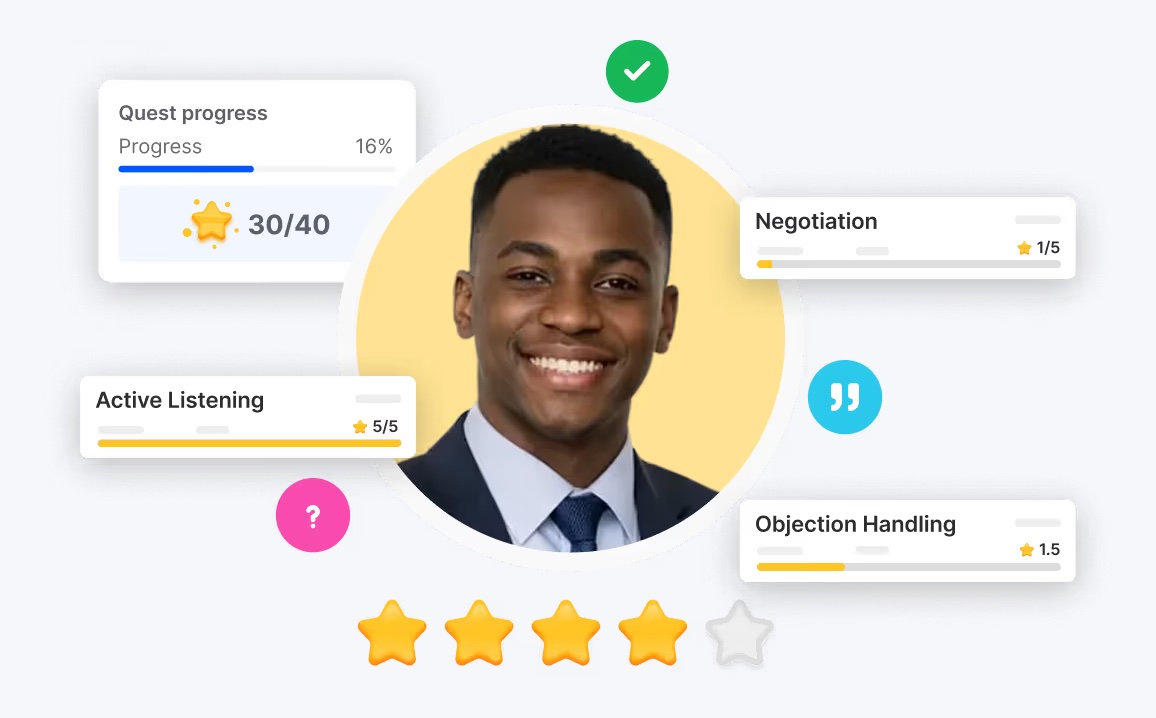
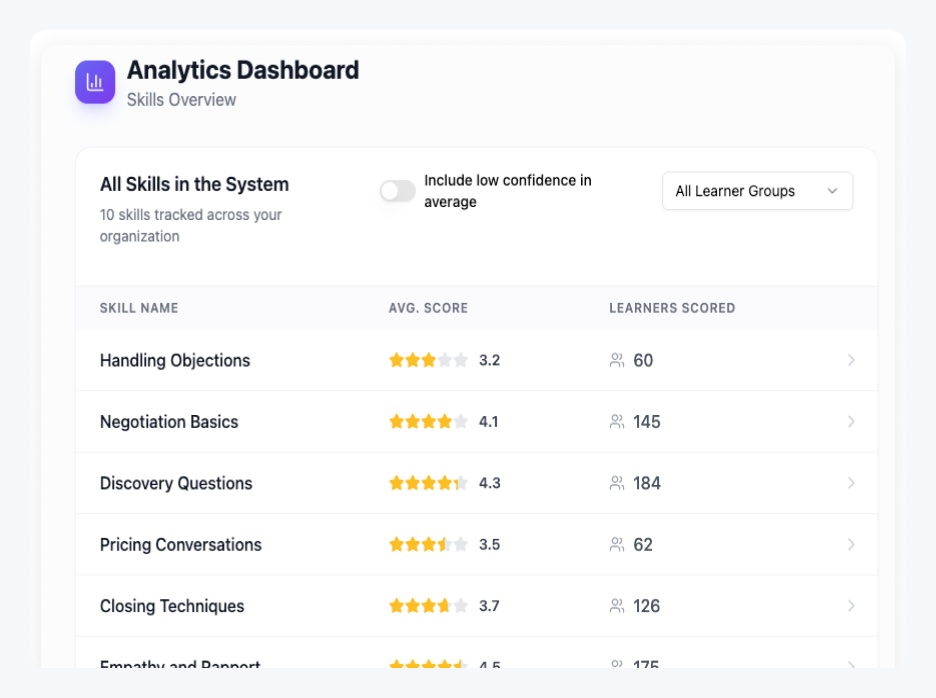
The setup starts with the job, not the course. For each key role a company wants to train, myQuest and the company feed the AI the skills that role needs, such as active listening, discovery questions or handling objections for a sales team, and empathy or problem analysis for a support team. Each skill is scored against defined evaluation criteria, tailored to what the organization needs, so a star rating stands for something specific. As people practice, the system builds a skill profile for each employee. The AI gives feedback as they go, and the profile updates by itself.
Go back to the sales rep from the start. On myQuest, the rep would practice the price objection out loud with an AI customer, get feedback on specific skills such as handling objections and discovery questions, and try again, before ever meeting the real customer.
Then comes what Edan calls phase two. Phase one gives everyone the same training to get them up to speed. In phase two, the system has learned each employee, sees where that person is weak, and starts training them on those gaps automatically. Managers get a view of their teams: who is struggling with which skill, and whether practice is turning into better performance over weeks and months.
What sets it apart is the combination. A company can put simulations, structured learning activities and ongoing skill measurement together into one complete development journey, and compare each person's assessments at different stages of it.
The company sells two products. myQuest Skills is the AI practice platform, built for roles centred on human interaction: sales, service, care and leadership. myQuest LMS is a learning system built around action, coaching and community. The website lists ISO 27001 and GDPR compliance, which large buyers look for.
Where it is heading, Edan says, is an agentic layer that watches over the skills in a whole organization. It would recommend what to do next, create the right content, and set up practice for the right people without anyone asking. Edan calls it an operating system for skills.
Startup mode, ten years in
myQuest is not new. Its website says it has served organizations since 2013, and Edan says the company raised its seed round about ten years ago, for what was in effect the previous generation of this product.
That company did well enough to pay its own way, and today it serves hundreds of customers around the world. But in Edan's own words, it did not explode. So the team is using the jump in AI to build a new generation of the product on its existing experience, customers and infrastructure, aimed at much larger organizations than before.
Ten years also gave the team practical knowledge of how organizations roll out training and keep learners engaged. That is what it brings to this new chapter, and it is hard for a new startup to learn quickly.
"We are like in a startup mode," Edan says, "but with a company that has been a while in the space."
What AI changed, in Edan's view, is not mainly content. Almost every tool now uses AI to build training content fast. The bigger change, and the one few organizations are using yet, is that AI can transform the way companies train people, not just the way they build content for them.
The team is ten people. Edan is in Tel Aviv, and the rest are spread across Israel, South Africa and the United States.
Proof from an auditor course
The clearest test so far is on myQuest's own site. In July 2026, Mérieux NutriSciences, which tests, audits and trains companies on food safety, ran its Internal Auditor course in a new hybrid format on myQuest. An instructor taught the material, then sent the class into the platform to practice. Each learner got instant AI feedback, and those results became the next discussion with the instructor. Every learner left with a personal dashboard of the competencies an internal auditor needs, scored one by one.
The old version of the course and the new one used the same final exam. The average score rose from 82% to 91%, and every learner in the hybrid group passed. Learner satisfaction rose from 6.5 to 7.6 out of 8. Several participants asked for more practice next time.
There are older cases too. myQuest's site shows Henkel using it to train sales professionals, and Clalit Health Services in Israel using it to train hundreds of healthcare providers.
Big companies, and the people who train them
myQuest sells to two kinds of customer. The first is large organizations training their own staff. The second is training and consulting companies, whose business is to deliver training to their clients, and who run that training on myQuest, and can put their own brand on it.
The second group is where the old product proved itself. On myQuest's site, the training firm Tidal Equality says it grew its training revenue seven times, and Profitability Works reports 75% growth while cutting costs. Training companies use it two ways: as a standalone online product that reaches more clients, or blended with their in-person consulting.
Edan is plain about who it is not for. A startup of ten people does not need it. The buyer is a company big enough to have roles worth training at scale, or a firm that trains those companies for a living.
LMS on one side, role-play on the other
Edan describes the field as two camps. On one side are the learning platforms that serve information to people. Cornerstone and Docebo run the corporate learning systems many large employers already have, and both now pitch skills intelligence. Degreed pulls learning from many sources into one place and tracks upskilling, and 360Learning lets experts inside a company build courses together. On the other side are the simulation tools. Second Nature and Hyperbound give sales teams AI role-play partners, Yoodli coaches people on how they speak, and Mursion runs immersive simulations for workplace conversations. What it does differently is tie the two camps together: it starts from the company's own skill framework for each role, turns that into AI practice, keeps a skill profile for every employee, and changes each person's training based on their gaps. It does that as a layer on top of the platform a company already has, and it is built to be resold by training companies to their own clients.
What they are looking for
Edan's two main priorities come first.
- Introductions to large North American organizations. This is the main ask. Edan wants someone with connections to big companies who can open doors, and is open to co-selling and sharing revenue with whoever does.
- Partnerships with training and consulting companies that deliver training to organizations and could build it on myQuest.
- Investors. Customers come first, but Edan is open to the conversation.
- Online speaking slots. Edan is happy to give talks online.
Book a demo or get in touch at myquest.co.
Why it is bigger than it sounds
This breed of startup is an old company that founds itself a second time. myQuest raised its seed round about ten years ago, grew to hundreds of customers around the world, and paid its own way. Building on that foundation, it is using AI to develop a new generation of its product, aimed at much bigger buyers. This is a very smart position.
Look at where the money comes from. The company already pays its own way, so the restart does not hang on a giant new round. And it walks into big-company sales with things a new startup takes years to collect: a decade of case studies, security certifications, a product that training firms already resell, and real results like an auditor course whose exam average jumped from 82% to 91%. A newcomer has the new technology. myQuest has the new technology, the track record and ten years of knowing how organizations actually train their people.
The formula: a company that survived the last era already has the customers, the trust and the revenue, and AI now lets it build the next generation of its product on top of them. The same play fits any steady software company of ten years or more, from school management systems to booking tools. Each one can run myQuest's move.
The risk in one line: the old product and the new one compete for the same ten people, and the new one has to beat startups that have nothing else to look after. If you run a company that pays its bills but stopped growing, AI is your chance to found it again, with a head start no newcomer can buy.
What to watch
The first thing is broader adoption of myQuest Skills among large North American organizations. Big buyers are the whole point of this new chapter, and more of them would prove it is working.
The second is phase two at scale. If the system can really learn each employee and train them on their gaps without a person designing every path, the operating system for skills stops being a slogan.
The third is the training companies. If firms that train other companies start selling myQuest to their clients, and co-sellers in North America open doors for a share of the revenue, a ten-person team gets a sales force far bigger than itself.