This summer's heat waves in Europe will cost farmers about 10 to 30% of their yield, depending on the crop. That is the estimate Giacomo Bastianelli gave us from Ghent, in Belgium. And plant breeding moves far slower than the weather. Breeders cross, select and wait, and getting a crop to handle that kind of stress the old way takes a decade or longer.
Giacomo's company is trying to cut that to five or ten years. The trick is to stop changing one gene at a time.
What they built
Rainbow Crops uses AI and gene editing to improve the traits that are hardest to change in a plant, such as yield and resistance to heat and drought. These traits do not sit in one gene. They are controlled by many genes working together, which is why they are so slow to improve.
The base tool is CRISPR, the discovery that won the Nobel Prize in Chemistry in 2020. It makes a precise change at a chosen spot in the genome, and Giacomo calls it probably the biggest biotech invention of the last 20 years. Most people use it to change one or two genes. What caught his eye was a way to use it, as he put it, "to create combinatorial population of plants with different combinations of mutations in a targeted way." In plain words: instead of one edited plant, you grow a whole crowd of plants, and each one carries a different mix of changes. The company calls these Rainbow Plant Populations. "We're talking about not five genes at a time, but 50-100," Giacomo told AgFunderNews in June.
Its platform is called Trait Foundry, and it runs as a loop. AI picks the genes most likely to matter. The lab edits them and crosses the plants. Automated systems measure every plant. Then the results go back into the AI, and the next round starts smarter.
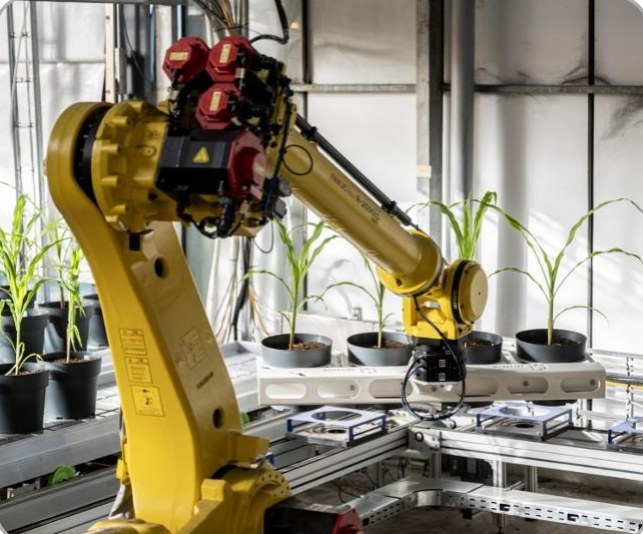
The method has already worked from start to finish in corn, up to field trials in Belgium.
Called in to build the company
Giacomo has spent 16 years in agricultural biotech, though his own background sits between pharmaceutical biotech and computer science. In 2010 he started a genome engineering company, Meiogenix. That company later moved to the United States. Giacomo stayed in Europe, sold his stake to a venture capital fund and moved on.
About three years ago, a research institute in Belgium called him. VIB had a new technology and wanted an entrepreneur to build the business case and raise money. He went to see it. The science came from the lab of Professor Hilde Nelissen, the scientific founder of the company, at the VIB-UGent Center for Plant Systems Biology, and it was the results that won him over. Rainbow Crops was founded as a spin-off in 2025, with Giacomo as CEO.
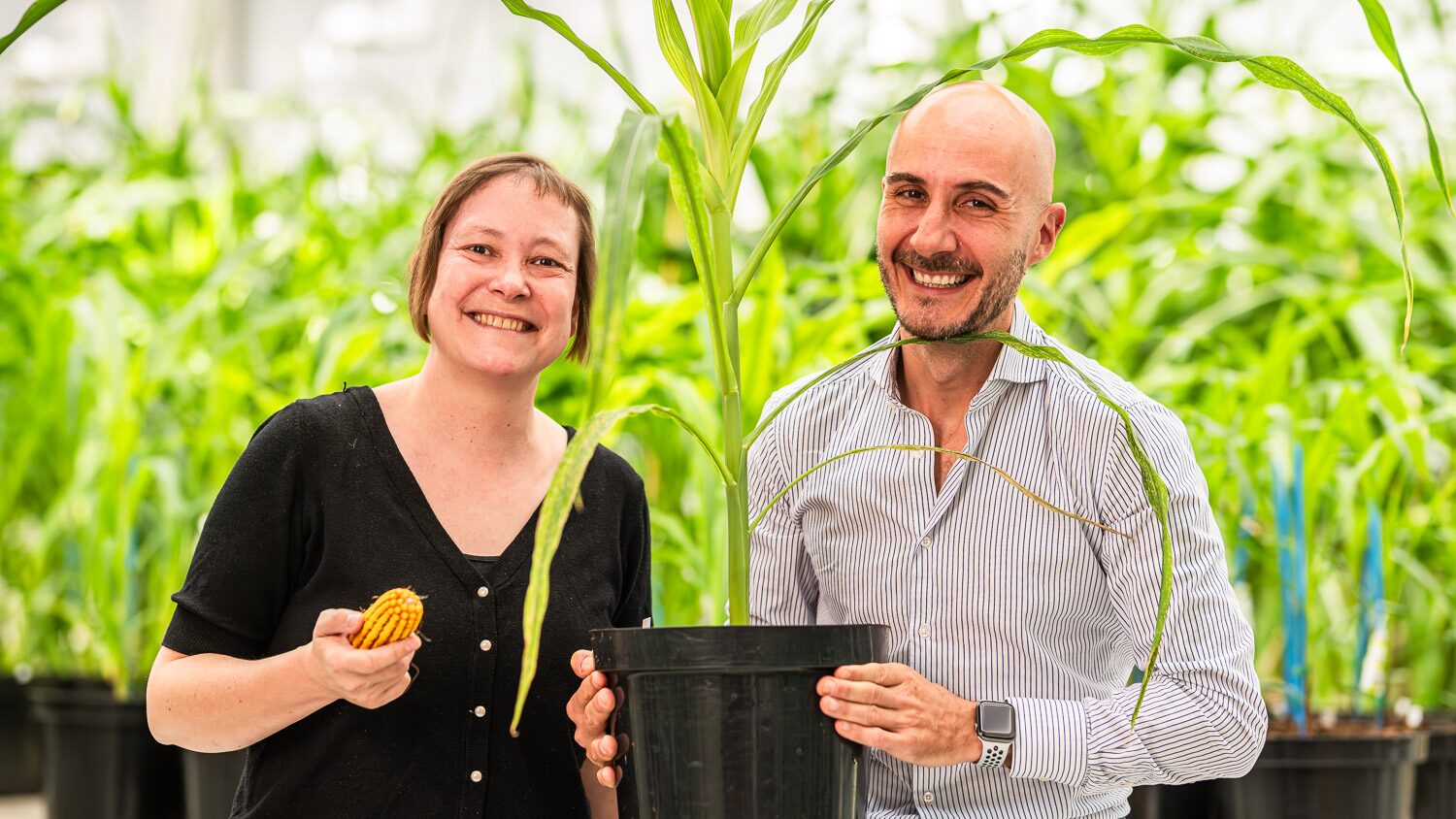
The team now has about a dozen people, across molecular biology, genome editing, AI and plant measurement.
Why Ghent
Asked what building a startup in Belgium is like, Giacomo did not talk about Belgium. He talked about Ghent. "There is a lot of history here for what we do," he said, "and there are a lot of talents and startups that originated from here." Some of the first genetic engineering of plants came out of this city. Plant Genetic Systems, founded in 1982 by two University of Ghent scientists, was sold and ended up inside Bayer. CropDesign, another Ghent company, is now owned by BASF.
Gates, and a giant
2026 has been a big year. In March, Rainbow Crops announced a US$7 million grant from the Gates Foundation to make corn, sorghum and rice better at handling heat and drought, for farmers in Africa and South Asia. In June, it closed a seed round of €9.7 million. Corteva was one of the investors.
Then in September came its second big programme. Vylor, the seed company that split off from Corteva on October 1 and one of the top three in the world, announced a partnership with Rainbow Crops to develop new gene-edited corn traits. What the trait is stays secret. "It's highly confidential," Giacomo told us.
Honest about the money
We asked Giacomo what an investor gets out of all this, and his answer was unusually straight. Classic venture capital grew up on software and hardware. Agriculture is different. Timelines are very long, and margins are small. A software investor who looks at his sector might say, in his words, "oh my God, I didn't know that is so long and you're not gonna have unicorn that easy in our sector."
Rainbow Crops does not sell seed. It is a technology partner for seed and breeding companies, which bring their own germplasm (the plant genetic material they breed from), the field trials and the path to market. The company earns money two ways: it licenses tested combinations of edits, for fees, milestones and royalties, and it develops new varieties together with partners. In March it told AgNavigator that it expects a first commercial product in four to five years.
He is just as careful about the promise itself. Asked if this means the world's food will be safe from climate change, he would not say yes. "I would love to give that security 100%," he said. "It's hard for me to give 100% as a scientist." What he will say is that the tools speed things up. Without them, the same goal "will take us more than a decade." With them, the first varieties could come in five to ten years.
Where it sits
Gene-edited crops are now a real field. Inari in Cambridge, Massachusetts, comes closest, pairing AI with multiplex editing, and it develops its own seeds. Pairwise in North Carolina is known for seedless blackberries and pitless cherries. Cibus in San Diego develops gene-edited traits for seed companies. Tropic in Norwich, England, started with tropical crops. Ohalo in California is working on a new way of breeding altogether. Avalo uses machine learning to speed up breeding, and Phytoform Labs and BetterSeeds also combine computing and gene editing for crops. And big seed companies, such as KWS in Germany, run their own breeding science.
What sets Rainbow Crops apart is that it puts AI, the editing of dozens of genes at once and automated measuring of plants into a single platform. Rather than competing in the seed market, it partners with seed and breeding companies to speed up the development of complex traits in their own germplasm.
What they are looking for
Rainbow Crops has just raised money, so Giacomo is not out fundraising. "It's always good to connect to investors when you don't need the money," he says.
- Seed companies across the globe that want to work on complex traits in their own crops.
- Investors who know agriculture, for a relationship now, ahead of the next round.
- Other agtech innovators. Giacomo is always open to giving them input and advice.
Reach the team at rainbowcrops.com.
Why it is bigger than it sounds
This breed of startup is very smart: when a problem has too many small causes, it stops picking one and starts testing the combinations.
Heat and drought are not one gene's problem, so a tool that fixes one gene at a time cannot reach them. Rainbow Crops turns one experiment into a crowd of plants, measures all of them by machine, and lets AI learn from each round. The money comes from the companies that already own the farmer. Seed companies have the germplasm, the field trials and the sales force. What most of them do not have is a fast way to find which combination works. So they pay fees and milestones as the work gets done, and a royalty when the seed sells. The Gates Foundation pays to take the same machine into tropical corn, sorghum and rice. Because Rainbow Crops sells no seed of its own, it competes with nobody it wants as a customer.
The formula: when a result depends on many things changing together and an industry still changes one at a time, build the machine that tests combinations at scale, and sell the winners to the companies that already own the customers. The same play fits wheat and soybeans, cattle and salmon breeding, the microbes that make food and fuel, cancer drug combinations, battery chemistry, metal alloys for aircraft, low-carbon cement recipes, and flavours and fragrances.
The bet in one line: the first commercial products are still years away, and agricultural biotech needs patient money, not software-style returns. If you run a seed company with strong germplasm of your own and want to speed up trait development, or you invest in food and climate with a long-term view, this is a team to call now.
What to watch
The first thing is Vylor. Giacomo told AgNavigator he hopes the deal sparks "open innovation and open partnerships between start-ups and the big players." If it produces a valuable corn trait, every other seed company will want to know how.
The second is the Gates Foundation project. Work on tropical corn, sorghum and rice will show whether Rainbow Crops' technology can deliver crops that stand up better to the climate across different species, and reach the farmers who need them most.
The third is Europe's new rules. In June 2026 the EU adopted a law that treats some gene-edited plants much like conventional ones, and it starts to apply in July 2028. Giacomo calls it "a green light on gene editing." If he is right, a company in Ghent will be working in a home market that welcomes what it makes.