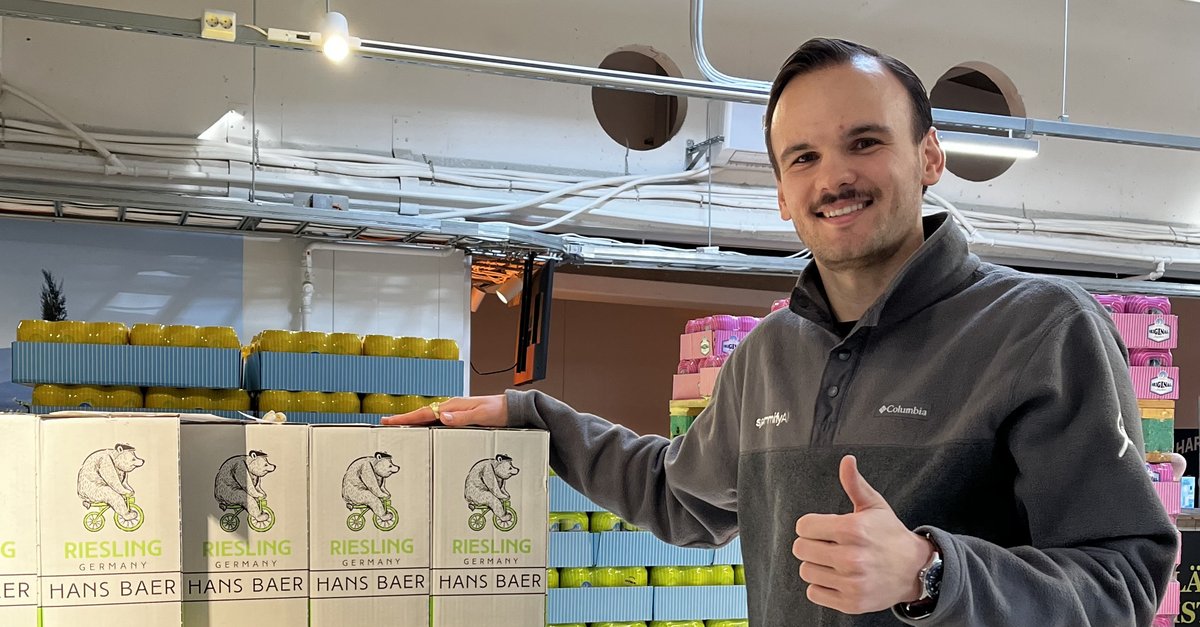
Jacob Pichna was born in Victoria, British Columbia, and lived his first years there. He was very small, and he does not remember much. "I just remember the sea," he says.
Today he runs sommify from Helsinki, and its software does one job that takes wine sales reps a disproportionately large amount of time. A large customer can carry 120 wines on its list. The rep's company may sell 3,000. Somebody has to pick the right 120, price them, match them to the menu and pitch them. By hand, Jacob says, "it will take forever." With sommify it takes about two minutes.
What they built
sommify calls itself the AI assistant for wine sales: "Catalogue in, curated offers out." It is built for wine distributors, wholesalers and importers, and for the sales reps who sell their wines to restaurants and shops.
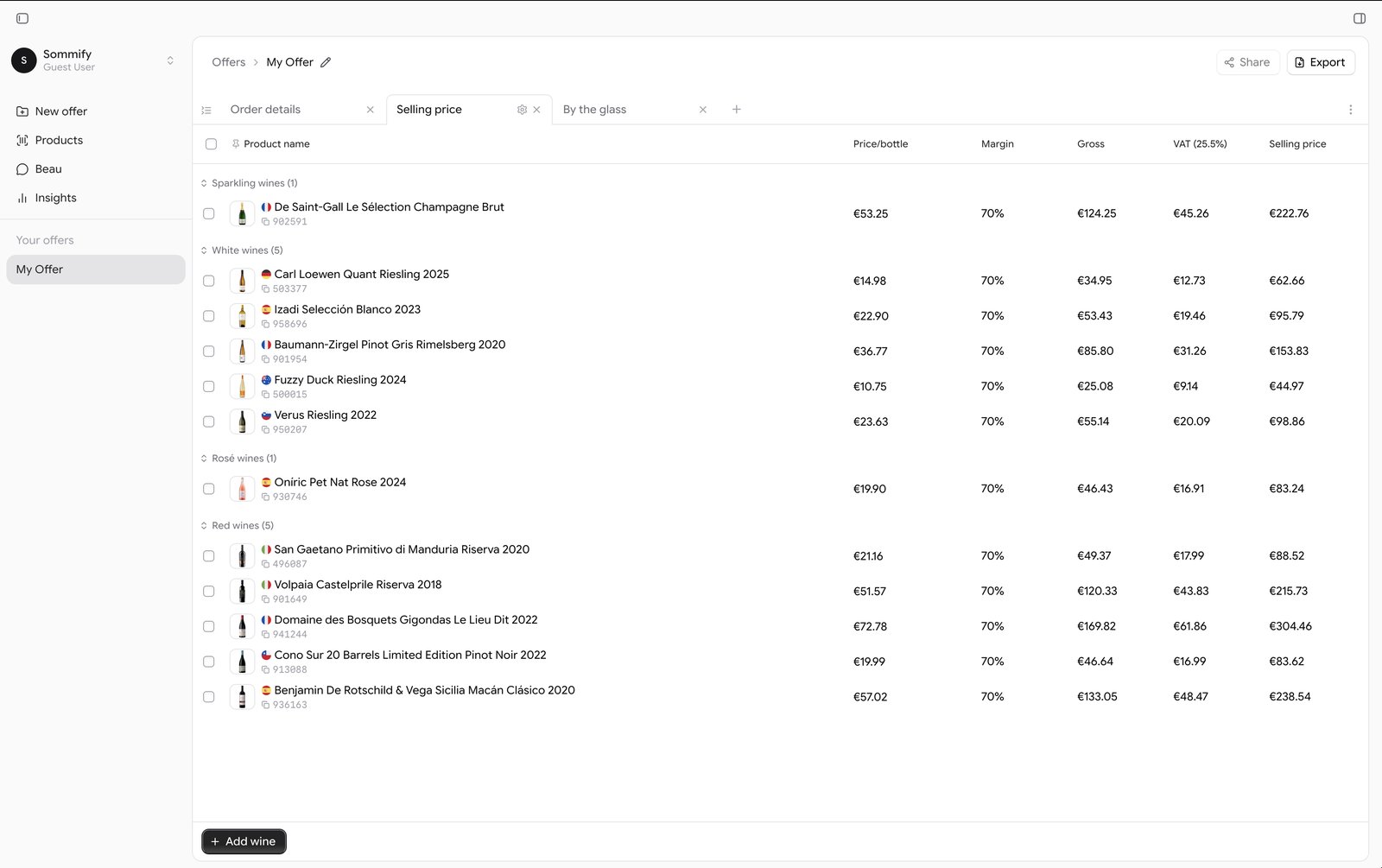
A rep clicks a few options and uploads what they know about the customer. Out comes a ready offer, a sales presentation, a pairing guide and a wine list. The website lists the main tools. Drop in a restaurant's menu and sommify builds a wine offer to match, dish by dish. Feed it a customer's current wine list and it matches every line to the closest wine in the distributor's own range, using the distributor's margins and rules for swaps. A pricing tool sets bottle and by-the-glass prices and shows the margin live. Beau, an AI sommelier inside the platform, answers questions about wine, stock, pairings and what to pitch under a budget. Every document comes out in the distributor's own brand, as PowerPoint, PDF, Word or Excel, in sixteen languages.
The proposal sommify sends to distributors puts numbers on each job. Building an offer drops from about an hour to five minutes. Pairing wines with a restaurant's food menu drops from an hour to two minutes. Taking over a rival distributor's wine list, matched wine for wine from your own range, drops from two hours to five minutes. Exporting a branded sales deck, which can take two hours by hand, is one click.
Jacob's pitch to distributors is simple: "I will make your sales reps efficient. They will save 30 hours a month." The reps can then spend that time on the relationship, and on meeting more customers.
Setting it up takes about three days, the website says. On day one the distributor shares its wine data in whatever form it has, from a spreadsheet to an export from its business system. On day two sommify builds it out. On day three the distributor goes live, on its own branded web address or inside its own systems. The standard plan costs USD 70 per seat per month, with no minimum number of users and no integration fee. A custom enterprise plan adds white labelling and a self-service version for the distributor's customers.
An exchange in Italy, and a sommelier
The idea started in 2019, Jacob thinks, on a student exchange in Italy. He lived in a wine region and started getting into wine. He knew nothing about it. "I was always thinking it's so difficult to choose the right wine," he says, "and the more I looked into it, the more kind of inaccessible and complex it felt."
So he contacted the people who are now his co-founders. In 2019 they were already studying AI development. "They were well ahead of the curve," he says. They built him a small tool to help him pick a wine, as a fun little project. He used it. Then he found that other people had the same problem, and the project "kind of just snowballed" into a company.
At first it was for consumers: help a person find the right wine for a dinner they are cooking, or for their own taste. To make the AI good, the team wanted a great sommelier's judgement inside it. They emailed 30 of the best sommeliers in the world, Jacob told the UK trade magazine The Buyer. Eight wanted to join, so sommify held a tournament that simulated the work, and Julie Dupouy won, with the most accessible style of them all. Jacob calls her "one of the best sommeliers in the world". She owns part of the company. Together they turned her wine knowledge into an AI model that suggests wine. They finished it about four months before ChatGPT launched. "So the timing was kind of terrible, but also kind of good," Jacob says, "because suddenly everyone was talking about AI, but they kept asking how is this different than ChatGPT."

Nine pivots in four years
The model worked. Finding someone to pay for it was harder. sommify raised its first venture money in 2022, and in the four years since it has pivoted nine times. "We have had a quite hard time of finding product market fit for that AI model that we built," Jacob says. "We have now found a product market fit."
He was always going to start a company. He has known it since the seventh grade. He studied business for that reason, then took a master's in law to have a wide background. He worked in banking and in consulting, and on evenings and weekends he kept trying to start something. Several of those ideas failed before this one started rolling. Looking back, he says he should have started earlier: "you can't really learn any of it except by actually doing it and making the mistakes yourself."

The company is lean today. At its peak sommify had ten people. "We overhired a bit," he says. Today it is five, and with the new AI tools that is enough to keep everything running. He expects to hire again in early 2027. He is also frank about money. He raised a pre-seed round in 2022 from a venture capital firm, a family office and angel investors. Since then he has topped it up with small bridge rounds and brought in new angels as the company grew. "I'm going to be very honest, I really don't like fundraising," he says. A big round takes about two months of a team's time, and he has not wanted to spend that until he was sure the round would be worth it.
Two weeks riding along with the reps
The pivot that worked came from watching the people who sell wine for a living. Jacob spent two weeks on ride-alongs with wine sales reps. He learned what they do in a day and looked for the parts sommify could automate or do better. Then the team built those parts into one platform.
The buyers are large distributors, and most of them sell much more than wine. Wine is the hard part. With most drinks, Jacob says, the choice comes down to brand or price. With wine there is the pairing and the taste of the customer, which are "very hard to train" and "incredibly time-consuming". That is the work sommify takes off the rep's desk.
He has also learned that wine alone is not enough. Reps adopt a tool only if it covers everything they sell. So sommify is now slowly adding other drinks, even though, in his words, it is "best at doing wine".
The timing has turned in his favour too. Wine is a very traditional trade, and many of its companies still work with pen and paper. Two years ago, Jacob says, he had to sell them on the idea of AI first and on his product second. Now every board and every CEO wants AI. "Now I don't have to sell them on AI. I just have to sell them on the product." The hard part is what comes after the yes. "They love the concept," he says. Then the talk turns to integrations and to whether the company has its data in order. "That's where it typically fails."
The 8,000 customers nobody visits
The rep tool is only step one. Jacob is very clear that step two does not replace the reps. "That's a big fear that companies have," he says.
He explains it with numbers. Say a distributor has 10,000 customers and 200 sales reps. There is no way those reps can visit all 10,000 in a year. About 8,000 will never meet a rep face to face. They order by clicking through an online portal, with no advice at all. "We want to serve those 8,000 like you serve the 2,000," Jacob says. The reps keep the big, high-margin customers. sommify takes care of the ones nobody would have served anyway.
The way in is the rep tool. Once a distributor's reps use it, sommify learns how that company sells wine. Then it builds a self-service version that goes into the distributor's web store, so every customer gets advice at the level of a sales rep, 24 hours a day, and can buy straight from the website. Later this year it goes live in its first web store, as a self-service option. That launch will show how well self-service sells.
Where it sits
AI that understands taste is a small but busy field. Preferabli sells what it calls Sensorial AI, software that understands human taste, to hospitality, travel, retail and consumer platforms. Tastry in California builds an AI model of human taste, smell and texture preference, to predict what consumers will love before a product is made. Vivino calls itself the world's largest wine marketplace, with reviews from its community. Hello Vino is a wine assistant app for shoppers, and SipSavvy puts an interactive digital sommelier on the restaurant table. In the wine trade itself, Bottlebooks helps the wine and drinks trade exchange product information, and Vinosmith sells a wine management platform for wineries and distributors. For ordering, Provi runs a B2B alcohol marketplace where bars, restaurants and shops connect with their reps and order, and SevenFifty connects importers, producers, distributors and retail buyers online. Ordermentum calls itself Australia's number one wholesale ordering platform for suppliers and venues. Choco gives food distributors AI ordering, digital storefronts and sales tools, and Pepper sells an AI-first platform to independent distributors. For sales teams in general, Seismic and Highspot sell AI sales enablement, Gong sells what it calls a revenue AI operating system, Pepperi sells B2B commerce for companies that sell through reps, and Repsly sells in-store execution software for consumer brands and their field teams.
The taste AIs mostly talk to the drinker, at home or at the table. The ordering platforms take the order but do not choose the wine. The sales tools manage slides and calls but know nothing about which white wine stands up to a dry-aged ribeye. sommify sits in the gap between them. It builds the offer a good rep would build, with the pairing and the price, in the distributor's own brand, and then puts the same knowledge in the web store for the customers no rep ever visits. Jacob says nobody else is doing this with a heavy focus on wine. That is his view, and in our reading of the companies above, none of them describes the same job.
What they are looking for
sommify makes money today, from a per-seat fee for every rep who uses it. It also offers a revenue share, but so far no distributor has taken it, because it is complex to account for. Jacob expects that to change with self-service, where online sales are easier to measure. The first web store launch is planned to move to a revenue share.
His plan for the next round is to hit a set of milestones first, probably in the first or second quarter of 2027: about USD 1 million in annual recurring revenue, the growth figures venture investors expect, and revenue from several customers in several markets. Then he wants to raise a larger seed round.
The road to North America runs through the UK. sommify already has two pilots there, which it hopes to make public soon. Jacob has spent time in the US, including four months in Silicon Valley, and his conclusion is that he must first prove in numbers that sommify works in one large English-speaking market outside the US. He has talks open with several US companies, and he says they are waiting for exactly that data. "There's so much potential in the US," he says. "I really want to get there, but I just want to get there without wasting time."
He also brings a view on investors that North American readers should hear. Many angels and VCs, he says, put too little weight on the founder and too much on the idea, when "the business will change like 50 times" before a company grows up. "In Europe, it's all about the business," he says. When we told him that investors in the US and Canada say they back the founder first, he agreed that spending a lot of time with the founder is "the best thing you can do." From North American readers, sommify wants:
- Wine and drinks distributors and importers in the US and Canada who want to talk now, ahead of the UK numbers.
- Distributors in the UK and other English-speaking markets with large sales teams and a busy web store.
- Seed investors for the larger round Jacob plans once the 2027 milestones are in.
You can book a call with a founder on sommify.ai. Reach Jacob at jacob@sommify.ai.
Why it is bigger than it sounds
This breed of startup is very smart: it gets in through the sales rep, learns how the company sells, and then sells that same knowledge to the customers no rep will ever visit.
The rep tool pays the bills. Distributors pay a fixed fee per seat, USD 70 a month on the standard plan, and they say yes because it saves their reps hours and because their boards want AI. But the real prize is the other 80% of customers. They already buy from the distributor, by clicking, with no advice. If self-service gives them a rep's advice and they buy a little more, or a little better, that money is easy to see. That is why the revenue share belongs there. A distributor with 200 reps pays sommify for 200 seats. A share of what its 8,000 unvisited customers buy online could be far larger, and it grows with every order. The rep tool also builds the moat. Once sommify has worked inside a distributor for a while, it knows how that company sells wine, and a rival starting fresh does not.
The formula: find a product where choosing is the hard part, sold by a wholesaler through reps who cannot visit everyone. Automate the rep's offer first, then put the rep's knowledge in the web store and take a share of the sales. The same play fits spirits, craft beer, coffee and tea sold to cafés, cheese and fine food sold to restaurants, and sake and shochu in Japan. It fits plants and seeds sold to farms and garden centres, paint and tiles sold to builders, auto parts sold to garages, and fabrics sold to designers. It fits the big wine and food wholesalers of Germany, France, Spain, Italy, Australia, Brazil, Mexico and South Korea. Wherever thousands of small customers order from a catalogue with no one to advise them, there is a sales rep's job waiting to be put online.
The risk in one line: distributors love the idea and then stall when they find their data is not ready, and the self-service step only goes live later this year. If you run a wine or drinks distributor, an importer or a foodservice wholesaler with a large sales team and a web store, or you invest in B2B AI with real customers, this is a team to call.
What to watch
The first thing is the first web store. Later this year sommify's self-service goes live in a distributor's web store. If those online customers buy more, sommify has its proof for the revenue share model.
The second is the UK. Jacob says US companies are waiting for quantified data from one large English-speaking market. sommify already has two pilots there, and Jacob hopes to make them public soon. Clear numbers from them are his ticket to the US.
The third is the 2027 seed round. Jacob's target is about USD 1 million in annual recurring revenue, from several customers in several markets, by the first or second quarter of 2027. Hitting it would turn a company that has lived on small bridge rounds into one raising a full seed.