In 2022, Mai Phan was caring for her grandfather. He was terminally ill. He had dementia, cancer and a lung infection, all at once. Like many people with dementia, he forgot things and said the same things again and again. Some of the care workers around him did not seem to have the patience for it. They got frustrated with him. Then the family got frustrated with them.
"During the care process, we did not know how to care for patients who had dementia," Mai writes on her company's website. "We also felt there was a communication gap between family members and care workers." Her grandfather died that year. Today Mai runs Variment in Oslo, and it builds practice for exactly those conversations: an old man shouting in the common room and asking for his wallet, a woman who refuses help at home, a relative who needs honest answers. Nurses, doctors, students and other health and care workers talk to them first, on a screen, so the hard conversation is not their first try with a real person.
What they built
Variment makes Varia, AI role-play for health and social care. You pick a simulation, then speak or type to a character who reacts to what you say. When the conversation ends, you get feedback on how you communicated and how much empathy you showed. It runs in a web browser on a computer, phone or tablet. There is no VR headset and nothing to install.
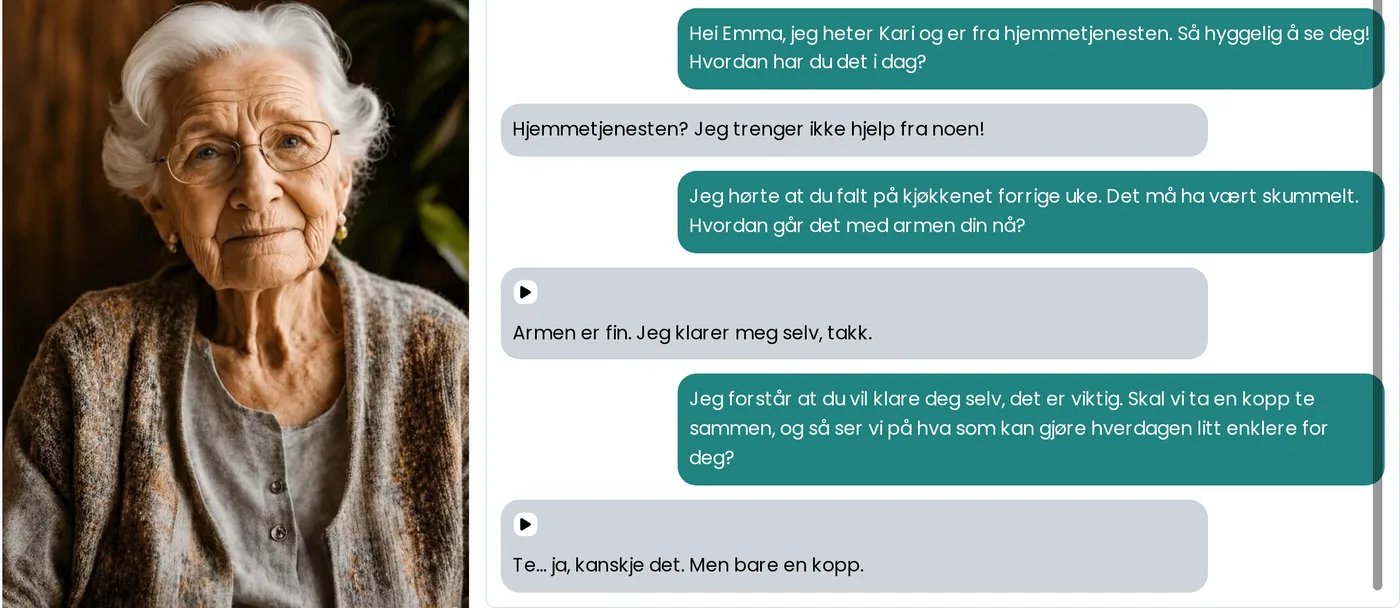
The demo on the website shows how it feels. The setup reads: "You are about to talk with Anders. He is in the common area, shouting at other residents and staff. Your goal is to help him calm down." You say hello. Anders answers: "I don't know. Where is my wallet?" You try: "You look a bit worried. Shall we look for your wallet together?" The feedback comes back: "You showed empathy and asked open questions. Next time, explore their concerns further." Anders is one of several characters. Fatima is for a conversation with a relative who needs reassurance and honest answers. Kari is for giving difficult feedback. Erlend is for someone who does not want to engage at all.
In the Norwegian version, the feedback screen scores each conversation on four good habits: invest in the beginning, show empathy, explore the other person's perspective, and invest in the end. Each habit gets a score out of 7, one line on what you did well, and one line with words you could use next time.
Varia is sold to two kinds of buyer. For schools, an instructor designs a patient case, Variment turns it into an AI character, and students practise in their own time before placement. For employers, a manager shares a simulation with staff, and each person gets their own feedback. Customers with a Creator licence can build and publish their own simulations. The simulations run in Norwegian and English.
Two Norwegian organisations use Varia today. One is a university, which uses the simulations in its bachelor's and master's programmes. The other is an employer that trains its own staff with them. Variment is also running pilots with two language schools in Norway that teach Norwegian to people who want to work in healthcare. The website says more than 200 people in Norway, Spain and the UK have tested Varia, and that 89% of them reported a boost in self-confidence. One nurse quoted on the site puts it simply: "When I ran the simulations, it was like talking to a real person; they even expressed their emotions."
From gas markets to the gym
Mai's road to health care is long, and it goes through three countries before Norway. She is from Vietnam. She took a bachelor's degree in business administration in the US and a master's in finance in the UK. In 2011 she got a job offer in Norway as an analyst following the global power and gas market, and she moved to Norway. She stayed in that job until 2017.
Then she left. Power and gas did not interest her, she says, and she had always been drawn to health and education. Her first business was a fitness centre. She worked as a personal trainer and taught fitness classes for children, adults and seniors. That ran until 2020, when COVID shut everything down and she was on maternity leave with her baby.
She used that time to think, and found that what she loved was running her own company. "You always learn something new. There's always new challenge," she says. Her corporate job had been the opposite: "At some point you basically know what you were supposed to do, and you kind of hit the ceiling."
The 200 companies that would not write the case
Her next step came through another founder, who was looking for a co-founder. Mai joined her. About a year later that founder left for a job at a company she had always wanted to work for, and Mai took over. The idea then was a game for hiring: a virtual work experience where job seekers and unemployed people could try real tasks in a digital world, and gain experience they could not get from an internship or a job.
Mai tested it through 2022 and 2023 and talked to about 200 companies in Norway. Most said much the same thing. It was interesting, but they had no time to write the cases themselves. If they joined, Mai says they told her, "you have to create the case for us because we don't have the time." For most of 2022 she was close to a solo founder. People joined the team and left again. "It was not a good match," she says.
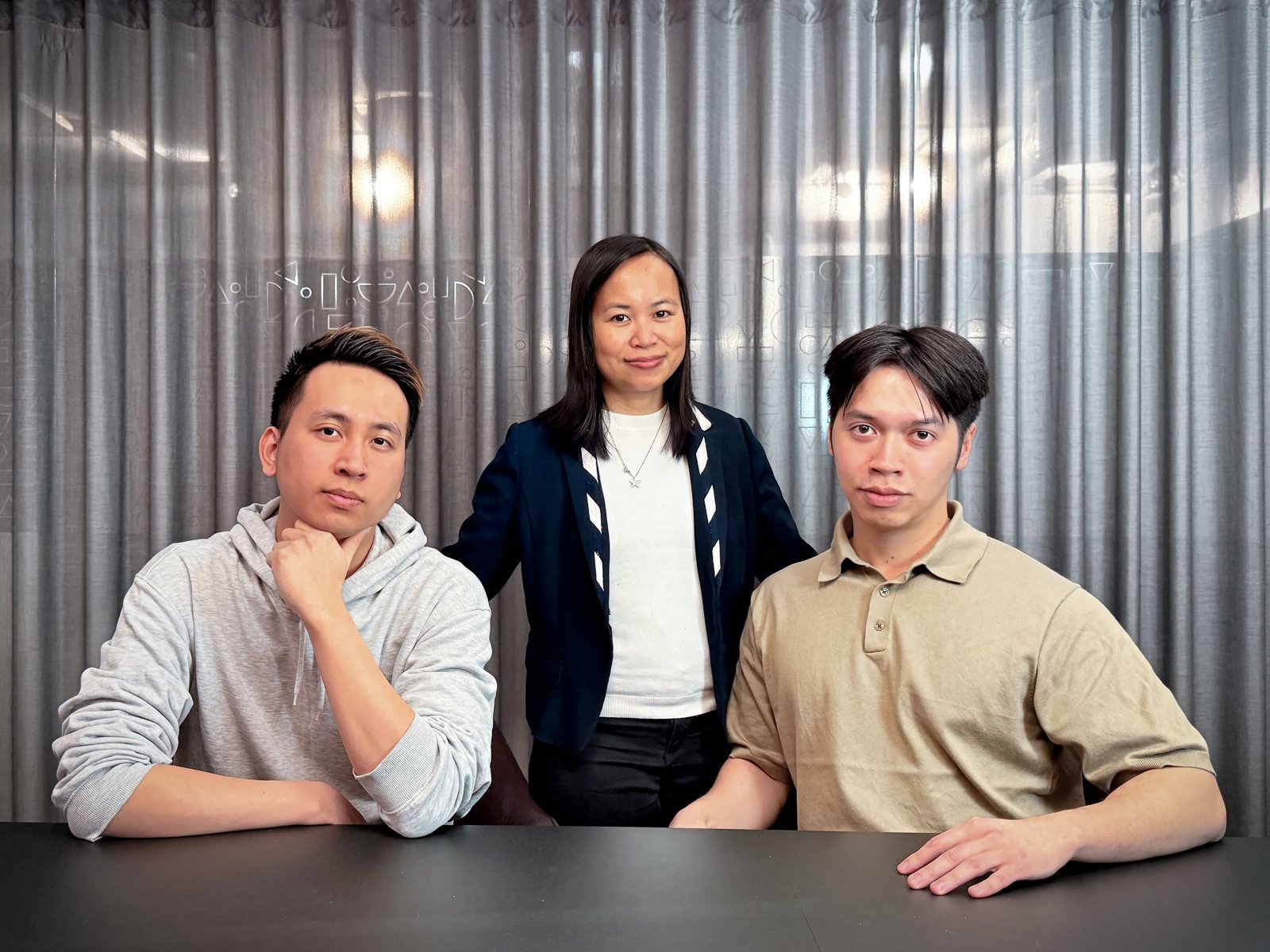
In 2023 Khanh Pham joined as co-founder and CTO. Variment's website describes him as a software and cybersecurity engineer who has built products used by hundreds of thousands of people. The two of them stepped back. "We can't just kind of run all over the place and keep testing with this idea," Mai says. "We have to get some traction somewhere." They looked for an industry that badly needs people, or is losing them, and needs a better way to train the ones it has. Two made the shortlist: schools, short of teachers in many countries, and health care, starting with nurses.
Two things decided it. The first was personal. Both founders had family members who were ill, and for Mai that was her grandfather. The second was a simple test. They contacted schools and hospitals with no product to sell, only a list of the problems they thought they saw, and asked if anyone wanted to talk. Many hospitals and healthcare organisations answered. The schools did not. Mai called and wrote and heard nothing back.
In 2024 the company took a new name, Variment, and turned to simulation in health care. Its first prototype was tested with nurses and students from Norway, the UK and Spain. In 2025 one of its first employees joined, in AI engineering. The lesson from the 200 companies stayed in the product. Variment does not ask a nursing school to write its own AI patient. The instructor describes the case, and Variment builds it.
Norwegian, dialect by dialect
Communication is the hardest part of care to teach, and language makes it harder. Health workers who come from abroad have to do all of this in a language they learned as adults. One of Variment's first pilots, in 2024, was with a staffing agency that recruits nurses from Spain to work in Norway. Today two of its pilots are with language schools that prepare people for work in Norwegian health care.
Norwegian is also not one language on the ward. Varia supports standard Norwegian Bokmål as well as different dialects, such as the way people speak in Oslo, Bergen and Trondheim. A resident in a Bergen nursing home does not sound like a language course recording.
Variment's pitch to employers is about more than kindness. Its website says one in three sick leaves in health and social services is job-related, that 42% of staff face high emotional demands at work, and that only 57% have ever had communication training, while 88% want more. It points to a 2024 study by Schram and colleagues on simulation training to argue that every hour of practice wins back 5.9 hours of working time. Those are the company's figures. The argument behind them is plain: better conversations mean fewer sick days and fewer people quitting.
Where it sits
Healthcare simulation is an old and large business. Laerdal Medical calls itself one of the world leaders in healthcare simulation, education and resuscitation training. SimX sells VR medical simulation for nurses, physicians and first responders, and Body Interact builds a virtual patient simulator to train critical thinking and decisions. Oscer uses AI virtual patients to practise diagnosis, history taking and examination. Closer to conversation, SimConverse, with offices in Sydney, Austin and London, sells AI role-play for skills training to universities and health services. Virti sells AI role-play with virtual humans to sales, service, leadership and medical teams, and Mursion sells immersive AI simulations to help companies upskill their staff. In Oslo itself, Attensi mixes game design, learning science and AI so employees can practise real work situations, and lists healthcare among its industries. Kognito builds practice-based digital learning on mental health for schools, campuses and communities. Bodyswaps lets students practise job interviews and difficult conversations with immersive AI role-plays. ClinRehearse in Dublin, another startup we wrote about, builds AI clients for counselling and crisis-line training. On the other side of the conversation, Hippocratic AI builds generative AI healthcare agents for health systems, insurers and drug companies.
The big simulators train hands and clinical decisions. The role-play platforms mostly sell to sales, service and management teams, or to students in general, and they start in English. Variment is narrow on purpose. It is built for the nursing home, the home visit and psychiatric care, for the confused resident and the worried relative, in Norwegian and its spoken dialects, for nurses who may have learned the language last year. And it was started by someone who sat on the family's side of that conversation.
What they are looking for
Variment is raising about USD 350,000, enough for 18 months of runway and the milestones in its plan. Its income today is pilot revenue plus grants, and its website says it closed a first round from angel investors and a venture fund in 2025. The team is five people: Mai, Khanh, an AI researcher, a doctor in Germany who works with them part-time, and a UX student.
The business model is an annual enterprise licence, priced by how many users a customer wants. On top of that come one-time fees for onboarding workshops and for building custom simulations. The customers are hospitals, universities and public long-term care, such as nursing homes and psychiatry. For 2027 the plan is about 15 customers in Norway, 4 pilots in Sweden and 3 in Germany, where Variment is already talking to possible customers. From 2028 it looks at the UK and the US.
Asia is not on the plan yet. Mai's reasoning is direct. Europe and North America are where the early adopters of simulation training are, with the new tools, research and conferences. In Norway, she says, when you talk about simulation to health professionals, "they understand it right away." In Asia she expects she would have to educate the market first. From North American and European readers, Variment wants:
- Investors for the USD 350,000 round.
- Pilot customers in Sweden and Germany: hospitals, nursing schools, nursing homes and psychiatric services.
- Early conversations in the UK and the US with nursing schools, simulation centres and care employers, ahead of 2028.
- Language schools and recruiters that prepare health workers from abroad for jobs in a new language.
You can try Varia for free on variment.io. Reach Mai at mai.phan@variment.io.
Why it is bigger than it sounds
This breed of startup is very smart: it trains care workers to talk, in the language of the country they work in.
Rich, ageing countries need more care workers than they can train at home, and many of the new ones come from abroad. A nurse from Spain can be an excellent nurse and still struggle when an old man with dementia shouts at her in a dialect she has never heard. Someone already pays to close that gap: the employer that recruited her, the language school, the nursing school, and often the state behind all three. Employers also pay for every sick day and every resignation. Variment sells into those budgets with an annual licence per user, and charges again to build each customer's own cases. Every new language is a new market for the same engine, and an English-only tool from California cannot simply walk into a Norwegian nursing home. In our opinion, that is the moat.
The formula: build role-play for the hardest conversations in one job, make it work in the local language and its dialects, and sell it to whoever pays to make new workers ready. The same play fits Germany, which recruits nurses from abroad to work in German. It fits Japan and South Korea, both ageing fast and both opening care jobs to workers from other countries. It fits the UK, Ireland, Canada and Australia, where many nurses were trained somewhere else, and Sweden, Denmark and Finland next door. It fits other jobs too: home helpers, childcare staff, pharmacy counters, hotel and cruise crews, social workers and police officers who meet newcomers every day. Whoever builds the most believable local resident first will be very hard to move.
The risk in one line: a team of five has to prove that practice on a screen changes real conversations, and win slow public buyers in three countries on USD 350,000. If you run a nursing school, a nursing home group or a language school for health workers, recruit nurses from abroad, or back early health software in Europe, this is a team to call.
What to watch
The first thing is Norway. Variment has two customers and two pilots today, and its plan calls for about 15 customers there in 2027. Turning the two language school pilots into paying customers would show the language angle is a business, not a side project.
The second is Germany. It is the first market in a new language, and a doctor in Germany already works with the team part-time. A German pilot that works as well as the Norwegian ones would show the engine travels.
The third is proof. Variment's own numbers so far are confidence scores from about 200 testers. A customer that reports lower sick leave or staff turnover after using Varia would be far stronger evidence. This is our opinion, not something Mai told us.