A weeding robot has to learn from pictures, and on a farm the pictures only come once a year. The team has maybe two months to collect them. By week nine or ten they are preparing the data, and that is when they find out that some rare cases are barely in it. The season is over. The robot goes out anyway, makes mistakes, and kills healthy crops.
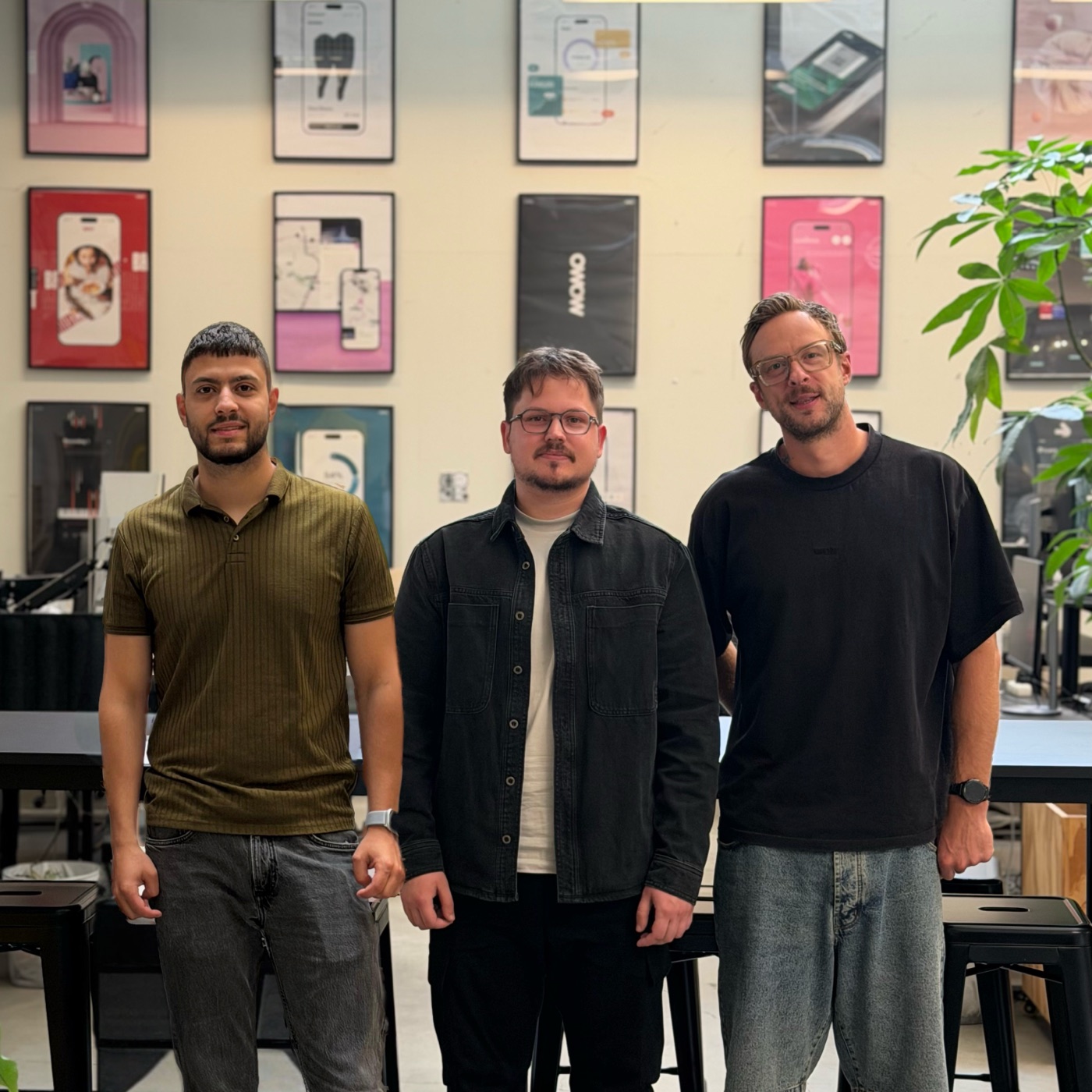
Martin Tomov and Simeon Dimov decided not to wait for next summer. Their company makes the missing pictures.
What they built
Synthgen, in Eindhoven in the Netherlands, makes synthetic data for computer vision, the cameras and software that let a robot or a factory line see. "We make better vision systems smarter by adding synthetic data to the training data," Martin told us. In plain words, it creates digital twins of real scenes, and makes sure the things that almost never happen are well represented.
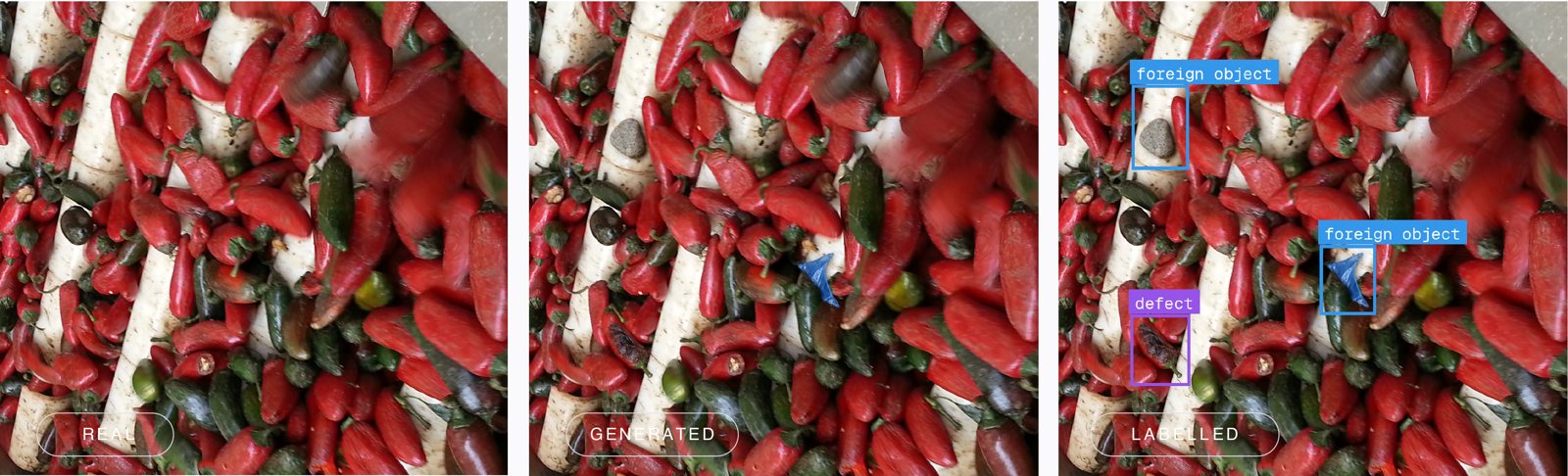
The problem it goes after is simple. A vision system sees thousands of images of the normal case and perhaps ten of the one that costs real money: a crack, a bad weld, a stone among the peppers. So it learns the common case well and the rare one badly. You cannot photograph your way out of that, Synthgen says on its blog, because the whole problem is that the thing almost never happens.
So the customer sends the photographs it already has, and Synthgen generates the missing defect into those same scenes, at true scale and in the same light. Because Synthgen placed the defect, it knows exactly where it is, so every image arrives already labelled. Nobody has to sit and draw boxes by hand, which Synthgen calls the part that costs the most. "The world is being automated faster than it can be photographed," Martin says in the company's presentation.
The company is unusually careful about proving it works. In June 2026 it published SCARCE, a public technical report with a placebo test built in. On the hardest class in each dataset, adding Synthgen's data lifted accuracy by 9 to 35 percentage points. For a faulty imprint on a pill, accuracy went from 46% to 81%. The report also includes the classes where synthetic data did not help. "A benchmark that only reports its wins is advertising," the company writes.
A few failures, then a drone project
Martin and Simeon were both born and raised in Sofia, Bulgaria, but they met at university in the Netherlands. Around 2022, after ChatGPT arrived, they decided generative AI was going to be huge and tried a few startups. A couple of them, in the creative industries, failed. "We didn't have the right timing and the right confidence at the time," Simeon says.
Then came a computer vision project at the university, for a drone startup run by a master's student. They saw there was demand for synthetic data, and started asking where it could fit. Martin describes what happened next as building blocks. First they tested the idea with that company. Then the university's incubator for entrepreneurs believed in it. Then they found a grant advisor and a partner company, Luxeed Robotics, a Dutch maker of farm robots that burn weeds with lasers instead of spraying them.
Together they won a two-year research grant under the Dutch MIT R&D scheme, run by the Netherlands Enterprise Agency, to study how synthetic data can reshape agriculture. Synthgen's blog puts its share at €124,000. Martin says about eight companies won out of hundreds. It was money that cost no shares, and it was proof that the idea was worth something. Synthgen was founded in late 2024, and the whole journey from student project to customers took under two years.
Then a venture studio in Eindhoven backed them with €200,000 in capital and services, in a pre-seed round announced in October 2026. Robin Dohmen came from that studio to join as the third co-founder, in charge of go-to-market. Simeon is the CEO and Martin the CTO.
Why Eindhoven
The Netherlands may not sound like a place full of factories. Martin disagrees. Western Europe is far more automated than Eastern Europe, he says, and the companies there have hit what he calls a research and development wall in their vision systems. Synthgen's region, North Brabant, has both halves of its market. There are many agriculture initiatives, and there is the chip industry around ASML and NXP.
Vegetables are a big part of the story. The Netherlands is a small country, but automation has made it one of the biggest vegetable producers in the world, Martin says. That creates a full chain of vision problems. The robot in the field has to tell a crop from a weed. The sorting company has to grade every pepper, so the worst go at the lowest price and the best at the highest. The supermarket has to check its self-checkouts and whether its shelves are tidy. "From the field to the check to the actual store," Martin says, "it's a full cycle of computer vision."
The same method works far from the farm. Synthgen has measured it on welds, pills, capsules, marble and wood, and it sells first into food and produce lines, precision agriculture, and electronics and precision manufacturing. For a factory, Martin says, it means fewer defects reaching a customer, fewer recalls and a better reputation.
The list behind the company is already long for its age. It is a Partner in Innovation at Fontys ICT, a member of the NVIDIA Inception programme and of Claude for Startups, and one of eight finalists in the AI Pitch Competition 2026.
Results, not a platform
Synthgen does not hand the customer a tool and wish them luck. It works in what Martin calls a results-as-a-service model. The customer hands over its data, has a few meetings, and gets results. The hours of research it takes to make synthetic data work are Synthgen's problem. "They don't need to hire a whole team," Simeon says.
Most customers start with a one-month Assessment at a fixed scope. Synthgen audits the data, finds the classes the model cannot learn, generates them, and measures the change on the customer's own photographs, kept aside before the work starts. After that the customer pays per generated and labelled image, or buys a monthly pack. Simeon adds that the team already knows livestock, agriculture, manufacturing and retail through its partners in the region, so a customer does not have to teach it the business first.
A European answer
Asked why a North American investor should look this far away, Martin started with Europe. "We want to make sure that for Europe there are alternatives for deep tech," he told us. The European Union, he says, does not want to depend fully on the United States when the biggest technology companies are all American. "We are trying to build a sovereign AI for Europe, and all of that starts with European data."
That sets up a very large opponent. "One of our main competitors about synthetic data is NVIDIA," he says. "We are trying to fight with one of the biggest, if not the biggest as of right now, companies in the world." But he does not see the product as locked to Europe. Farms and factories work the same way almost everywhere, and he calls the United States and Canada allies in the tech sector. The team has also talked about building some hardware of its own as a natural next step.
Where it sits
Synthetic data for machines that see is a busy field. NVIDIA Omniverse gives developers tools to build simulated worlds. Parallel Domain in San Francisco creates synthetic sensor data, and Anyverse sells physics-based simulation for cars and robots. SKY ENGINE AI offers a synthetic data cloud for computer vision, and Bifrost builds simulation tools for robotics. On the labelling side, Roboflow, Encord and V7 give teams the tools to label and manage their images. Robot makers such as Carbon Robotics in Seattle and Aigen show how much vision now matters on the farm.
Most of those tools expect a customer to have vision engineers who will learn and run them. What they do not do is start from one rare defect on the customer's own line, do the work for them, and prove the gain on the customer's own photographs.
What they are looking for
Synthgen has closed its pre-seed round and is working with a few customers in the Netherlands. From North American readers, it wants:
- Computer vision teams whose model keeps missing the one class that matters, on food and produce lines, in precision agriculture, and in electronics and precision manufacturing.
- Farm robotics and sorting companies in the United States and Canada that lose a season every time their data comes up short.
- Investors in physical AI for the next round, which Martin says could also take the company into hardware.
Reach the team at synthgen.co or hello@synthgen.co.
Why it is bigger than it sounds
This breed of startup is very smart: it sells the picture that was never taken.
Everyone building physical AI has the same hidden bottleneck, and it is not the model. It is the rare event. The crack, the contaminant and the sick plant are the cases that cost the money, and they are exactly the cases nobody has enough photos of. Today a customer pays for that gap with months of collecting, a labelling bill, recalls and dead crops. Synthgen turns the gap into a price list: a fixed Assessment that proves the gain, then a fee for every image it generates and labels. Each new product, new line and new defect is another order, so the customer never really finishes buying. And because the proof is measured on the customer's own photographs, the sale makes itself.
The formula: wherever a machine has to learn from something that almost never happens, stop waiting for it to happen. Manufacture the example, label it as you make it, and charge for the measured result. The same play fits rare diseases in hospital scans, airport baggage screening, cracks in railway tracks, damage on wind turbine blades, pipeline leaks, early signs of wildfire, insurance claim photos and warehouse robots.
The risk in one line: NVIDIA can afford to give synthetic data tools away to sell more chips, so Synthgen has to win on hands-on results and on being European. If you run a vision team with a defect you can never collect enough of, or you invest in physical AI and want a way into Europe, this is a team to call.
What to watch
The first thing is the final of the AI Pitch Competition on November 12 at the Evoluon in Eindhoven.
The second is the farm. The grant project with Luxeed Robotics runs until 2027. If laser weeding robots trained on Synthgen's images reach the field in numbers, that is the proof the whole food chain will want to see.
The third is who comes calling. In our view, a company built as a European alternative is also a natural way in for a North American giant that wants European customers.