Quentin d'Huart's family manages a few forests in Belgium. On his company's website, he describes watching his father spend hours measuring trees in the forest, then more hours typing the same numbers into a computer. And in Europe, he told us, a forest passes from parents to children and gets cut into smaller pieces with every generation, one piece for each child. Every new owner inherits the same question: how do you manage this?
Quentin's answer started as a gadget for measuring trees. Today it is a platform that follows a log from the plot where it grew to the sawmill that cuts it. From the end of this year, the European Union will want that kind of proof for the wood sold in its market.
What they built
Timbtrack, based in La Hulpe, just south of Brussels, makes software for everyone who handles wood before it becomes a product: forest owners and managers, forest contractors and sawmills. Its website sums it up in one line: IoT, satellite data and RFID on one platform.
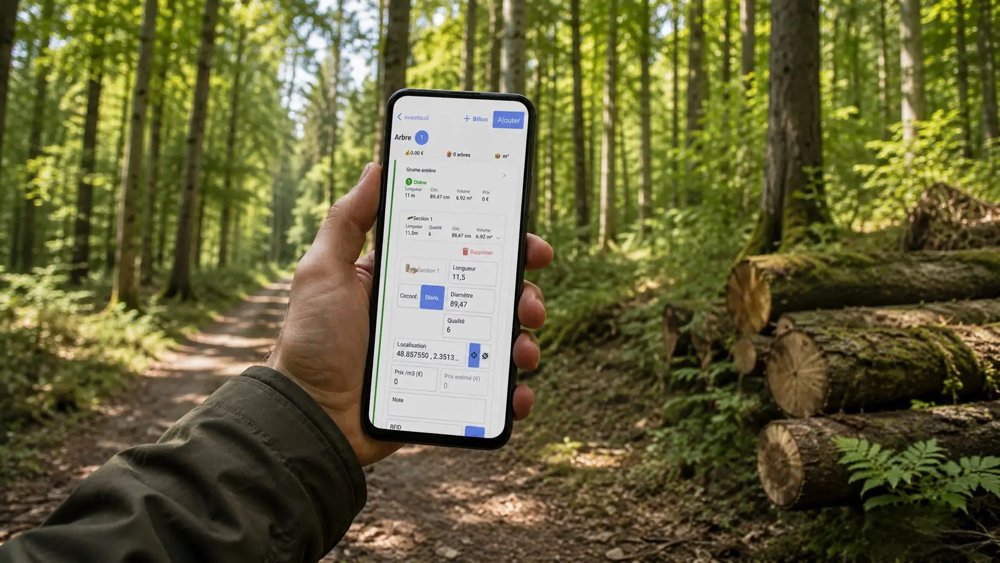
Here is how it works. A forest owner or manager draws plots, trees, paths and water points on one shared map, and adds tree species, sizes, dead trees and work to be done. The data can come from old inventories or from Timbtrack's phone app, which works deep in the forest with no network and syncs once it is back in range. Satellites watch from above. In a European project called FOREST.AI, Timbtrack is building in alerts from GoodForest, a company that analyses images from the Copernicus Sentinel satellites with AI. Its website lists four alerts: a monthly warning for the spruce bark beetle, an estimate of trees blown down after a storm, a check on dying stands every two weeks and a measure of damage after a fire. Quentin says fire detectors from partners now feed in as well.
Then the wood moves. Each log can carry its own ID, often a forestry RFID tag, which links it to its plot, its supplier and its papers. When the sawmill receives it, the log goes into stock with its history attached. When it is sawn, that history passes on to the lots, pallets and boards that come out of it. The website promises all of this "without typing anything twice", which is exactly the job Quentin's father was doing by hand.
There is more around the core. Réglobois tells French forest contractors which permits and forms a cut needs. Arbre en ville lets a city keep a record for every street tree. For temperate forests, it offers a free plan and a paid Plus plan. Syncing the phone app with the platform is for paying users. Tropical concessions get an offer built for them.
From a measuring tape to a platform
Timbtrack began as a project more than a company, Quentin says. The company website says he came back from a business venture in Africa and turned to the forest market in 2014. His first idea was hardware: a device to measure each tree. Volume is the unit a forest is sold by, so it tells an owner which trees to sell and which to leave to grow. The device became a connected forestry measuring tape. The data went into a very simple platform that spat out an Excel file.
COVID changed the plan. Timbtrack stopped making hardware and became a software company. Instead of building every sensor itself, it started pulling in data from other technologies and other companies, all onto one platform. It hired more developers and added services one by one: satellite health checks, then fire detection, then tools for forest contractors and sawmills, and traceability between all of them.
Quentin has no regrets. "Making a hardware device is super complicated. It's very costly," he says. The hardware years left the team with a good understanding of sensors, so it now speaks the same language as the hardware companies whose data it brings in. Forestry knowledge, sensors and software in one small team, he says, is a good combination.
The forestry world has noticed. The company's website lists innovation prizes from Demo Forest in 2019, 2022 and 2026, and from the Walloon wood industry in 2021. It also calls Timbtrack the Belgian leader in digital tools for the forest.
One map for everyone
We asked why a team in Belgium can do this when others cannot. Quentin's first answer is the market itself. Forestry in Europe is a niche, and "you know what's happening in it if you are already in it." Outsiders find it hard to break in. Clients like Timbtrack, he says, because "we know what is a forest and how to manage it."
His second answer comes from a client. The Fédération Nationale du Bois, France's national wood federation, told the team what it likes most: a vision that brings all the operators together and puts every useful forest technology on the same map. Without that, a forester uses one platform for one job, another platform for the next job, and the data ends up scattered. With it, every forester and manager finds what they need in one place.
A law with a date on it
The European Union's Deforestation Regulation, called EUDR in English and RDUE in French, is Timbtrack's biggest driver. Its website explains it plainly. Wood is one of seven raw materials covered. Wood and many wood products can be sold in the EU, or exported from it, only if they are legal in the country where they were grown and are not linked to deforestation or forest damage after December 31, 2020. That means knowing the country and, where the rule asks for it, the exact location of the plot the wood came from. Medium and large companies, and small timber firms that were already under the EU's older timber rules, must comply from December 30, 2026. Other micro and small firms have until June 30, 2027.
Timbtrack sells the proof. The plot is already on its map, the log already carries its tag, and the papers are already attached. The website is careful to add that the platform helps with the checks but does not replace the company's own risk assessment or its legal duty.
Quentin says the law matters most right now in the tropics. That is where Timbtrack is pushing. Its website describes a study of timber traceability across the whole of Guyana with the country's forestry administration, which ended with a proposal for a new connected system for the country. For the Rainforest Alliance, it traced a single table from the Petcacab sawmill in Mexico all the way to the CIB 2026 timber fair in Nantes, France. And Quentin says a very big national project is now starting in Benin, in West Africa.
In Europe, Timbtrack started in Belgium and now works across western Europe and in the east, in Latvia most of all. Projects in Sweden are starting. The code is written in Belgium. The customers are wherever the forests are.
Seven people and a lot of doors
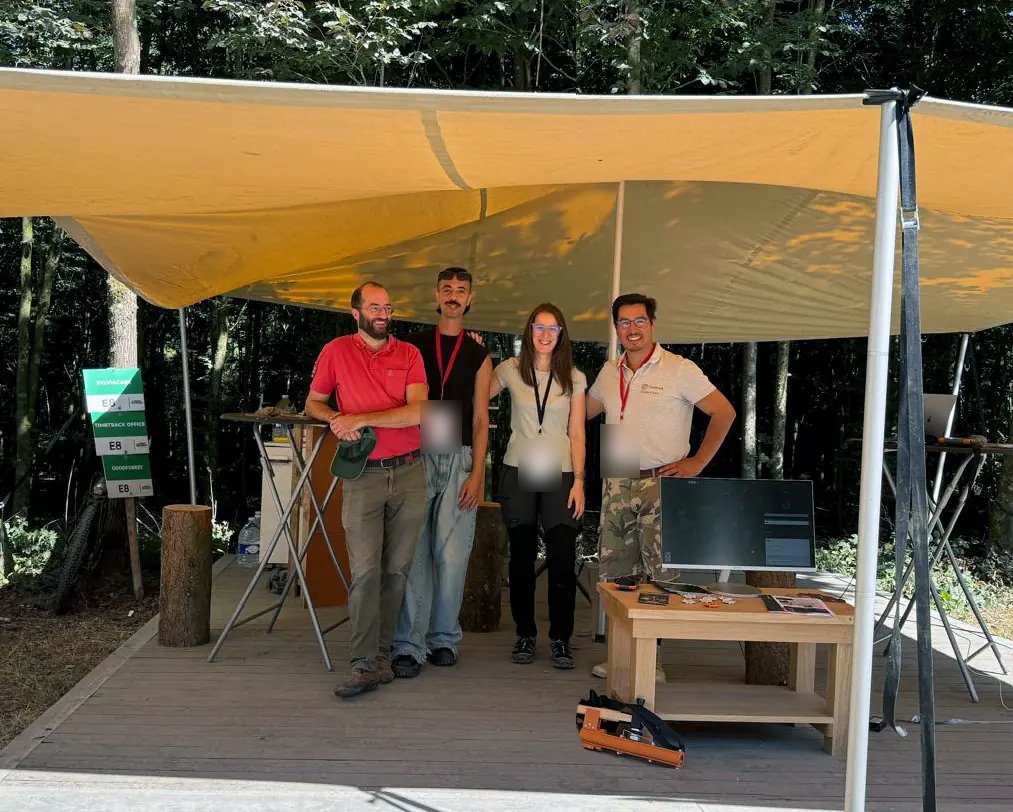
Timbtrack has 7 people. "We are 7 for the moment, and it's too small, obviously," Quentin says. The team watches every euro it spends. It already earns revenue.
Canada is one of the doors it wants to open again. Just before COVID, Timbtrack visited Quebec and met a forestry group there. Then everything went on hold. Last year, at a forestry fair, Thomas Castadot, Timbtrack's Sales and Business Development Director, showed the platform to the team from Trimble in Canada. The platform was less developed than it is now, he says, but the Trimble team told them it was very interesting for forestry companies in Canada. "To be honest, we have a lot of demands and we can't be everywhere," Thomas says. That is the problem the next round of money is meant to solve.
Where it sits
Forest technology is full of companies that each do one part of the job very well. Trimble, the giant, sells a suite of forestry software from forest management to wood buying, logistics and the mill. Remsoft in Fredericton, New Brunswick, sells planning and optimization software for forest management and the forestry supply chain. Treemetrics in Cork, Ireland, runs ForestHQ, a forest management platform built to make owners audit-ready. In Finland, Arbonaut sells precision forestry data and CollectiveCrunch sells forest data products, including a tool for buying land or timber. Arboair analyses every single tree from aerial images, and Deep Forestry in Uppsala, Sweden, flies drones beneath the canopy to measure what grows there. Flash Forest in Toronto plants trees with drones and surveys forests with LiDAR and AI. For fire, Dryad Networks in Germany builds sensors for ultra-early wildfire detection and OroraTech spots wildfires from space. For the new law, Satelligence in the Netherlands uses satellite data to help supply chains stay EUDR-compliant, Meridia in Amsterdam checks field data for farm commodity supply chains, and Koltiva sells traceability software for agricultural supply chains.
Each of them owns one slice: a sensor, a drone, a satellite feed, a planning model, a suite from forest to mill, or a compliance check for crops like cocoa and coffee. What none of them does is the thing the French wood federation praised: take in everyone else's technology, put the forest owner, the contractor and the sawmill on one shared map, and follow a single log by its tag from the plot where it grew to the board that leaves the mill, with a free plan a family forest owner can start on.
What they are looking for
This is Timbtrack's second raise. Before COVID, it raised about €600,000, and during COVID it received about €200,000 in support. At the start of this year, it was asking for $2 million. Quentin stresses that the figure may have changed. In the summer, the team paused the raise to focus on sales, but it is still open. The money is for reach, not for code: the products are mature, Quentin says, and every new country takes time, from the first talks to the field mission to the first customers. He wants to go faster and reach more people at once, especially in the tropics, where the EUDR matters most today. From North American readers, Timbtrack wants:
- Investors, venture funds and angels who back forestry and environmental technology, including in Canada and British Columbia, where forestry is a big industry.
- Forestry companies, sawmills and forest managers in Canada, for the return to the Canadian market that Trimble's interest pointed to.
- Introductions to anyone in North American forestry who can open the next door.
Reach Thomas at thomas.castadot@timbtrack.com.
Why it is bigger than it sounds
This breed of startup is very smart: it gets every link of a supply chain onto one shared record before a law makes that record compulsory.
Follow the money. Forest owners can start for free, and they pay when they want the phone app synced and the extra features of the Plus plan. Sawmills pay to receive, stock and trace their logs. Tropical concessions and governments pay for systems built for them, the way Guyana and Benin are working with Timbtrack. Now add the law. Under the EUDR, the first company to put wood on the EU market must show where it grew. That information starts in the forest, on the owner's map. If the owner already keeps that map in Timbtrack, the contractor and the sawmill have every reason to use the same system, and each new link makes it harder for the next one to choose another. The law does not pay Timbtrack. It makes Timbtrack's customers need each other's data. And once the history of every plot and every log lives in one place, nobody wants to move it. This is our opinion.
The formula: find a supply chain where a new law demands proof of origin, and become the shared record that the first link already uses. The same play fits the other raw materials under the same EU law: cocoa from Ivory Coast and Ghana, coffee from Ethiopia, Colombia and Brazil, palm oil and rubber from Indonesia and Malaysia, and soy and cattle from Brazil and Argentina. Timbtrack's own website already offers feasibility studies for cocoa, coffee, soy, palm oil and rubber, and it has studied a census of olive trees and their growers in Morocco. The play fits batteries, which need a digital passport under EU battery rules. It fits fish, where the EU asks for catch certificates to keep out illegal fishing. It fits steel, cement and aluminium under Europe's carbon border tax. And it fits Canada: wood from British Columbia sold into Europe falls under the same law, even though the EUDR gives a simpler procedure to suppliers from low-risk countries. Whoever holds the first record in the chain gets the rest of the chain.
The risk in one line: the sales lean on a law that Europe has already delayed and softened, and it could change again. If you invest in forestry or climate technology, or you run a forestry company, a sawmill or a timber export business in Canada that sells wood into Europe, this is a team to call.
What to watch
The first thing is the round. Timbtrack paused its raise of about $2 million in the summer. Whether it reopens, at what size, and whether a Canadian investor joins will show how much the EUDR deadline has changed the story.
The second is Benin. A national project there would put a whole country's timber on one system. If it works, it is the model for other tropical countries that export wood to Europe, Guyana first among them. This is our opinion, not something Timbtrack told us.
The third is Canada. Trimble's team already called the platform very interesting for Canadian forestry. A first Canadian customer or partner, in Quebec where the team has been before or in British Columbia, would turn that interest into a market.